Ch. 18 - Reactions of Benzene and Substituted Benzenes
Bruice - Organic Chemistry 8th Edition
Bruice8th EditionOrganic ChemistryISBN: 9780135213711Non è quello che usi tu?Cambia libro di testo
Capitolo 18, Problema 45g

Draw the structure for each of the following:
g. o-nitroanisole

Guida verificata passo dopo passo
1
Understand the name 'o-nitroanisole': The prefix 'o-' stands for 'ortho', which indicates that the substituents on the benzene ring are adjacent to each other (1,2-positions). The 'nitro' group (-NO₂) and the 'anisole' group (methoxy group, -OCH₃) are the substituents.
Start with the benzene ring as the base structure. Benzene is a six-membered aromatic ring with alternating double bonds.
Place the methoxy group (-OCH₃) on one of the carbons of the benzene ring. This is the defining feature of anisole.
Add the nitro group (-NO₂) to the carbon adjacent to the one with the methoxy group. This placement corresponds to the 'ortho' (o-) position.
Verify the structure: Ensure that the benzene ring has six carbons, alternating double bonds, and the substituents (methoxy and nitro groups) are correctly placed in the 1,2-positions relative to each other.

Risposta video verificata per un problema simile:

Questa soluzione video è stata consigliata dai nostri tutor come utile per risolvere questo problema.
Durata del video:
2m

Concetti chiave

Ecco i concetti essenziali che devi comprendere per rispondere correttamente alla domanda.

Aromatic Compounds

Aromatic compounds are a class of cyclic compounds that follow Huckel's rule, which states that they must have a planar structure with a specific number of pi electrons (4n + 2, where n is a non-negative integer). These compounds exhibit unique stability due to resonance, making them distinct from aliphatic compounds. Understanding the structure of aromatic compounds is essential for drawing and interpreting their chemical structures.
Video consigliato:
08:19
Intro to Aromaticity

Substituent Effects

Substituent effects refer to how different groups attached to a benzene ring influence its reactivity and the positions where new substituents can be added. In the case of o-nitroanisole, the nitro group (-NO2) is a strong electron-withdrawing group that directs incoming substituents to the ortho and para positions relative to itself. Recognizing these effects is crucial for accurately depicting the structure of substituted aromatic compounds.
Video consigliato:
Percorso guidato
2:02
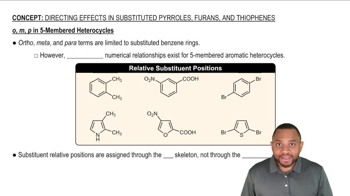
Directing Effects in Substituted Pyrroles, Furans, and Thiophenes Concept 1

Functional Groups

Functional groups are specific groups of atoms within molecules that are responsible for the characteristic chemical reactions of those molecules. In o-nitroanisole, the methoxy group (-OCH3) and the nitro group (-NO2) are key functional groups that define its chemical behavior. Understanding these groups helps in predicting the properties and reactivity of the compound, as well as in drawing its correct structure.
Video consigliato:
02:36
Identifying Functional Groups