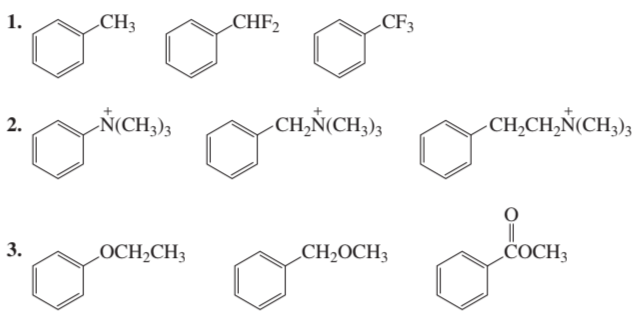
Rank the following substituted anilines from most basic to least basic:
Ch. 18 - Reactions of Benzene and Substituted Benzenes
Tutti i libri di testo
Bruice 8th Edition
Ch. 18 - Reactions of Benzene and Substituted Benzenes
Problema 50a
Bruice 8th Edition
Ch. 18 - Reactions of Benzene and Substituted Benzenes
Problema 50aCapitolo 18, Problema 50a
For each horizontal row of substituted benzenes, indicate
a. the one that is the most reactive in an electrophilic aromatic substitution reaction.

Guida verificata passo dopo passo1
Step 1: Analyze the substituents attached to the benzene ring in each compound. The substituents are CH3 (methyl group) in compound I, CH2Cl (chloromethyl group) in compound II, CHCl2 (dichloromethyl group) in compound III, and CCl3 (trichloromethyl group) in compound IV.
Step 2: Determine the electronic effects of each substituent. The methyl group in compound I is an electron-donating group due to hyperconjugation and inductive effects. The chloromethyl, dichloromethyl, and trichloromethyl groups in compounds II, III, and IV are electron-withdrawing groups due to the electronegativity of chlorine atoms.
Step 3: Recall that electron-donating groups increase the reactivity of the benzene ring in electrophilic aromatic substitution reactions by stabilizing the intermediate carbocation formed during the reaction. Conversely, electron-withdrawing groups decrease the reactivity by destabilizing the intermediate carbocation.
Step 4: Compare the substituents. The methyl group in compound I is the strongest electron-donating group among the four substituents, while the trichloromethyl group in compound IV is the strongest electron-withdrawing group. The reactivity decreases as the number of chlorine atoms increases in compounds II, III, and IV.
Step 5: Conclude that compound I, with the methyl group, is the most reactive in electrophilic aromatic substitution reactions because the methyl group enhances the electron density of the benzene ring, making it more attractive to electrophiles.

Risposta video verificata per un problema simile:
Questa soluzione video è stata consigliata dai nostri tutor come utile per risolvere questo problema.
Durata del video:
4mConcetti chiave
Ecco i concetti essenziali che devi comprendere per rispondere correttamente alla domanda.
Electrophilic Aromatic Substitution (EAS)
Electrophilic Aromatic Substitution is a fundamental reaction in organic chemistry where an electrophile replaces a hydrogen atom on an aromatic ring. The reactivity of the aromatic compound is influenced by the nature of substituents already present on the ring, which can either activate or deactivate the ring towards further substitution.
Video consigliato:
EAS Review
Activating and Deactivating Groups
Substituents on a benzene ring can be classified as activating or deactivating based on their electronic effects. Activating groups, such as alkyl groups, donate electron density to the ring, enhancing its reactivity towards electrophiles. In contrast, deactivating groups, such as halogens, withdraw electron density, making the ring less reactive in EAS reactions.
Video consigliato:
Activating and deactivating groups
Resonance Effects
Resonance effects play a crucial role in determining the reactivity of substituted benzenes. Electron-donating groups stabilize the positive charge of the intermediate formed during EAS, while electron-withdrawing groups destabilize it. Understanding how these resonance structures influence the stability of intermediates helps predict which substituted benzene will be the most reactive in EAS.
Video consigliato:
Understanding Resonance Effects
Pratica correlata
Domanda del libro di testo
1182
views
Domanda del libro di testo
For each horizontal row of substituted benzenes, indicate
c. the one that yields the highest percentage of meta product in an electrophilic aromatic substitution reaction.
1.
2.
921
views
Domanda del libro di testo
Draw the product(s) of each of the following reactions:
d. o-methylaniline + benzenediazonium chloride
728
views
Domanda del libro di testo
Draw the product(s) of each of the following reactions:
h. m-xylene + Na2Cr2O7 + HCl + ∆
70
views
Domanda del libro di testo
For each horizontal row of substituted benzenes, indicate
c. the one that yields the highest percentage of meta product in an electrophilic aromatic substitution reaction.
3.
609
views
Domanda del libro di testo
For each horizontal row of substituted benzenes, indicate
c. the one that yields the highest percentage of meta product in an electrophilic aromatic substitution reaction.
1175
views