Ch. 18 - Reactions of Benzene and Substituted Benzenes
Bruice - Organic Chemistry 8th Edition
Bruice8th EditionOrganic ChemistryISBN: 9780135213711Non è quello che usi tu?Cambia libro di testo
Capitolo 18, Problema 88b

Propose a mechanism for each of the following reactions:
b.

Guida verificata passo dopo passo
1
Step 1: Identify the functional groups present in the reactants and the type of reaction. Look for any nucleophiles, electrophiles, or leaving groups that might be involved in the mechanism.
Step 2: Determine the first step of the mechanism, which often involves the formation of a reactive intermediate. This could be the attack of a nucleophile on an electrophile or the departure of a leaving group.
Step 3: Consider any rearrangements or shifts that might occur in the intermediate. This could involve carbocation rearrangements or shifts of electrons to stabilize the intermediate.
Step 4: Identify the final step where the product is formed. This often involves the stabilization of the intermediate and the formation of new bonds.
Step 5: Review the entire mechanism to ensure that it follows the principles of organic chemistry, such as charge conservation and the stability of intermediates. Make sure each step logically leads to the next and results in the final product.

Risposta video verificata per un problema simile:

Questa soluzione video è stata consigliata dai nostri tutor come utile per risolvere questo problema.
Durata del video:
10m

Concetti chiave

Ecco i concetti essenziali che devi comprendere per rispondere correttamente alla domanda.

Reaction Mechanism

A reaction mechanism is a step-by-step description of how reactants transform into products in a chemical reaction. It outlines the sequence of elementary steps, including bond breaking and formation, and the intermediates formed during the process. Understanding the mechanism is crucial for predicting the outcome of reactions and for designing new synthetic pathways.
Video consigliato:
02:16
Heck Reaction Mechanism

Nucleophiles and Electrophiles

Nucleophiles are species that donate an electron pair to form a chemical bond, while electrophiles are electron-deficient species that accept an electron pair. The interaction between nucleophiles and electrophiles is fundamental in organic reactions, as it drives the formation of new bonds. Identifying these species in a reaction helps in predicting the mechanism and the products formed.
Video consigliato:
03:
Nucleophile or Electrophile

Catalysis

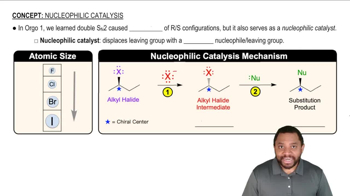
Catalysis refers to the process of increasing the rate of a chemical reaction by adding a substance known as a catalyst, which is not consumed in the reaction. Catalysts can provide an alternative pathway with a lower activation energy, making reactions more efficient. Understanding the role of catalysts is essential for proposing mechanisms, especially in complex organic reactions.
Video consigliato:
Percorso guidato
2:31
Nucleophilic Catalysis Concept 1
Pratica correlata
Domanda del libro di testo

Show how the following compounds can be prepared from benzene:

c.

1158
views

Domanda del libro di testo

The pKa values of a few ortho-, meta-, and para-substituted benzoic acids are shown below:

The relative pKa values depend on the substituent. For chloro-substituted benzoic acids, the ortho isomer is the most acidic and the para isomer is the least acidic; for nitro-substituted benzoic acids, the ortho isomer is the most acidic and the meta isomer is the least acidic; and for amino-substituted benzoic acids, the meta isomer is the most acidic and the ortho isomer is the least acidic. Explain these relative acidities.

c. NH2: meta > para > ortho

657
views
Domanda del libro di testo

When heated with chromic acid, compound A forms benzoic acid. Identify compound A from its 1H NMR spectrum.

<IMAGE>

1265
views
Domanda del libro di testo

How can you distinguish the following compounds using: a. their infrared spectra?

1426
views
Domanda del libro di testo

The pKa values of a few ortho-, meta-, and para-substituted benzoic acids are shown below:

The relative pKa values depend on the substituent. For chloro-substituted benzoic acids, the ortho isomer is the most acidic and the para isomer is the least acidic; for nitro-substituted benzoic acids, the ortho isomer is the most acidic and the meta isomer is the least acidic; and for amino-substituted benzoic acids, the meta isomer is the most acidic and the ortho isomer is the least acidic.

Explain these relative acidities.

a. Cl: ortho > meta > para

4578
views
Domanda del libro di testo

Propose a mechanism for each of the following reactions:

a.

1043
views