Ch. 18 - Reactions of Benzene and Substituted Benzenes
Bruice - Organic Chemistry 8th Edition
Bruice8th EditionOrganic ChemistryISBN: 9780135213711Non è quello che usi tu?Cambia libro di testo
Capitolo 18, Problema 52f

Show how the following compounds can be synthesized from benzene:
f. m-hydroxybenzoic acid

Guida verificata passo dopo passo
1
Step 1: Begin with benzene as the starting material. Perform a nitration reaction by treating benzene with a mixture of concentrated HNO₃ and H₂SO₄. This introduces a nitro group (-NO₂) onto the benzene ring, forming nitrobenzene.
Step 2: Reduce the nitro group (-NO₂) in nitrobenzene to an amino group (-NH₂) using a reducing agent such as Sn/HCl or Fe/HCl. This forms aniline.
Step 3: Protect the amino group (-NH₂) by acetylation. React aniline with acetic anhydride to form acetanilide. This step prevents unwanted reactions during subsequent steps.
Step 4: Perform a Friedel-Crafts acylation reaction on acetanilide using CO₂ and AlCl₃ to introduce a carboxylic acid group (-COOH) in the meta position relative to the protected amino group. This forms m-acetylaminobenzoic acid.
Step 5: Hydrolyze the acetanilide group under acidic or basic conditions to remove the acetyl group and regenerate the amino group. Then oxidize the amino group to a hydroxyl group (-OH) using a suitable oxidizing agent, such as NaNO₂/HCl, to yield m-hydroxybenzoic acid.

Risposta video verificata per un problema simile:

Questa soluzione video è stata consigliata dai nostri tutor come utile per risolvere questo problema.
Durata del video:
7m

Concetti chiave

Ecco i concetti essenziali che devi comprendere per rispondere correttamente alla domanda.

Electrophilic Aromatic Substitution

Electrophilic aromatic substitution (EAS) is a fundamental reaction in organic chemistry where an electrophile replaces a hydrogen atom on an aromatic ring. This process is crucial for synthesizing substituted aromatic compounds, such as m-hydroxybenzoic acid from benzene. Understanding the mechanism of EAS, including the role of the electrophile and the stability of the carbocation intermediate, is essential for predicting the products of reactions involving benzene derivatives.
Video consigliato:
03:07
EAS Review

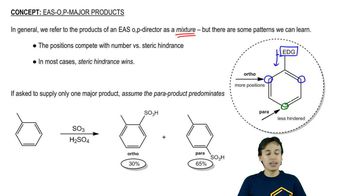
Ortho/Para vs. Meta Directing Groups

In electrophilic aromatic substitution, substituents on the benzene ring can influence the position of further substitutions. Ortho and para directing groups favor substitution at the 2 and 4 positions, while meta directing groups lead to substitution at the 3 position. Recognizing the directing effects of functional groups, such as hydroxyl (-OH) and carboxylic acid (-COOH), is vital for determining the correct synthesis pathway for m-hydroxybenzoic acid.
Video consigliato:
04:42
Ortho, Para major products

Functional Group Transformations

Functional group transformations involve converting one functional group into another through various chemical reactions. In the synthesis of m-hydroxybenzoic acid, the transformation of a nitrile (-CN) group into a carboxylic acid (-COOH) is a key step. Familiarity with common reactions, such as hydrolysis of nitriles, is necessary to understand how to achieve the desired functional groups in the final product.
Video consigliato:
02:36
Identifying Functional Groups