Ch. 18 - Reactions of Benzene and Substituted Benzenes
Bruice - Organic Chemistry 8th Edition
Bruice8th EditionOrganic ChemistryISBN: 9780135213711Non è quello che usi tu?Cambia libro di testo
Capitolo 18, Problema 47c

What product is obtained from the reaction of excess benzene with each of the following reagents?
c. dichloromethane + AlCl3

Guida verificata passo dopo passo
1
Identify the type of reaction: The reaction involves benzene, dichloromethane (CH2Cl2), and aluminum chloride (AlCl3). This is a Friedel-Crafts alkylation reaction, where an alkyl group is introduced to the benzene ring using a Lewis acid catalyst (AlCl3).
Understand the role of the reagents: AlCl3 acts as a Lewis acid catalyst, which helps generate a carbocation from dichloromethane. The dichloromethane molecule (CH2Cl2) can lose a chloride ion (Cl⁻) to form a chloromethyl carbocation (CH2⁺Cl).
Generate the electrophile: The AlCl3 reacts with one of the chlorine atoms in CH2Cl2, forming a complex that facilitates the departure of Cl⁻ and generates the chloromethyl carbocation (CH2⁺Cl). This carbocation is the electrophile that will react with benzene.
Perform the electrophilic aromatic substitution: The benzene ring donates a pair of π-electrons to the chloromethyl carbocation (CH2⁺Cl), forming a sigma complex (an intermediate where the benzene ring is temporarily non-aromatic). A proton (H⁺) is then lost from the intermediate, restoring the aromaticity of the benzene ring and yielding the product.
Determine the product: Since excess benzene is present, the reaction will likely stop after the introduction of one chloromethyl group to the benzene ring. The final product is chloromethylbenzene (C6H5CH2Cl).

Risposta video verificata per un problema simile:

Questa soluzione video è stata consigliata dai nostri tutor come utile per risolvere questo problema.

Concetti chiave

Ecco i concetti essenziali che devi comprendere per rispondere correttamente alla domanda.

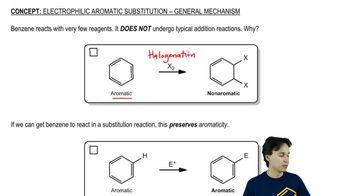
Electrophilic Aromatic Substitution

Electrophilic aromatic substitution (EAS) is a fundamental reaction in organic chemistry where an electrophile replaces a hydrogen atom on an aromatic ring. In the presence of a Lewis acid catalyst like AlCl3, benzene can react with electrophiles, leading to the formation of substituted aromatic compounds. Understanding EAS is crucial for predicting the products of reactions involving benzene and various reagents.
Video consigliato:
03:07
EAS Review

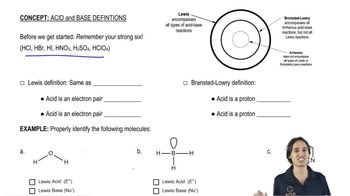
Lewis Acids and Bases

Lewis acids are substances that can accept an electron pair, while Lewis bases donate an electron pair. In the context of the reaction with dichloromethane and AlCl3, the AlCl3 acts as a Lewis acid, facilitating the generation of a more reactive electrophile from dichloromethane. This interaction is essential for the electrophilic substitution process to occur effectively.
Video consigliato:
02:49
The Lewis definition of acids and bases.

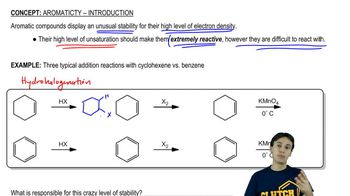
Reactivity of Aromatic Compounds

Aromatic compounds, such as benzene, are characterized by their stability due to resonance and delocalized electrons. However, their reactivity can be influenced by the nature of the substituents and the conditions of the reaction. In this case, the presence of excess benzene and a strong Lewis acid like AlCl3 can enhance the reactivity of benzene, allowing it to undergo substitution with the electrophile generated from dichloromethane.
Video consigliato:
08:19
Intro to Aromaticity