Ch. 18 - Reactions of Benzene and Substituted Benzenes
Bruice - Organic Chemistry 8th Edition
Bruice8th EditionOrganic ChemistryISBN: 9780135213711Non è quello che usi tu?Cambia libro di testo
Capitolo 18, Problema 84b

What reagents are required to carry out the following synthesis?
Synthesis pathway showing the conversion of a carboxylic acid to an acid chloride with reaction arrows.

Guida verificata passo dopo passo
1
Step 1: Analyze the starting material and the first intermediate. The starting material is a ketone with an aromatic ring and an alpha-beta unsaturated system. The intermediate (after reagent A) is a carboxylate ion, indicating that the ketone has undergone oxidation.
Step 2: Identify the type of reaction that converts a ketone to a carboxylate ion. This is typically achieved using strong oxidizing agents such as potassium permanganate (KMnO4) or sodium hypochlorite (NaOCl) under basic conditions.
Step 3: Examine the second transformation (intermediate to product). The carboxylate ion is converted into an ester. This suggests a reaction between the carboxylate and an alcohol in the presence of an acid catalyst, which is characteristic of esterification.
Step 4: Determine the alcohol required for esterification. The product contains an ethyl group attached to the oxygen of the ester, indicating that ethanol (CH3CH2OH) is the alcohol used in the reaction.
Step 5: Summarize the reagents. Reagent A is a strong oxidizing agent such as KMnO4 or NaOCl under basic conditions to oxidize the ketone to a carboxylate. Reagent B is ethanol (CH3CH2OH) and an acid catalyst (e.g., H2SO4) to perform esterification.

Risposta video verificata per un problema simile:

Questa soluzione video è stata consigliata dai nostri tutor come utile per risolvere questo problema.
Durata del video:
5m

Concetti chiave

Ecco i concetti essenziali che devi comprendere per rispondere correttamente alla domanda.

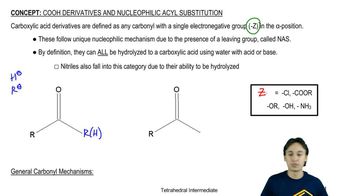
Carboxylic Acid Derivatives

Carboxylic acids can be converted into various derivatives, such as acid chlorides, esters, and amides. Acid chlorides are particularly reactive and can be synthesized from carboxylic acids using reagents like thionyl chloride or oxalyl chloride. Understanding these derivatives is crucial for predicting the reactivity and transformation of carboxylic acids in organic synthesis.
Video consigliato:
03:50
Intro to Carboxylic Acid Derivatives

Reagents for Synthesis

In organic synthesis, specific reagents are required to facilitate chemical transformations. For the conversion of a carboxylic acid to an acid chloride, reagents such as thionyl chloride (SOCl2) or oxalyl chloride ((COCl)2) are commonly used. Identifying the correct reagents is essential for successfully carrying out the desired reaction and achieving the target compound.
Video consigliato:
Percorso guidato
1:16
Synthesis of Amino Acids: Strecker Synthesis Example 1

Mechanism of Nucleophilic Acyl Substitution

The conversion of carboxylic acids to acid chlorides involves a nucleophilic acyl substitution mechanism. In this process, the nucleophile (the chloride ion from the reagent) attacks the carbonyl carbon of the carboxylic acid, leading to the formation of the acid chloride. Understanding this mechanism helps in predicting the outcome of the reaction and the stability of intermediates formed during the synthesis.
Video consigliato:
01:47
Nucleophiles and Electrophiles can react in Substitution Reactions.