Ch. 19 - More About Amines • Reactions of Heterocyclic Compounds
Bruice - Organic Chemistry 8th Edition
Bruice8th EditionOrganic ChemistryISBN: 9780135213711Non è quello che usi tu?Cambia libro di testo
Capitolo 19, Problema 27

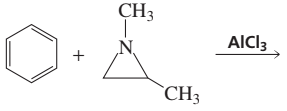
Benzene undergoes electrophilic aromatic substitution reactions with aziridines in the presence of a Lewis acid such as AlCl3.
a. What are the major and minor products of the following reaction?
b. Would you expect epoxides to undergo similar reactions?

Guida verificata passo dopo passo
1
Step 1: Understand the reaction mechanism. Benzene undergoes electrophilic aromatic substitution (EAS) reactions, where an electrophile replaces one of the hydrogen atoms on the aromatic ring. In this case, aziridines act as electrophiles in the presence of a Lewis acid like AlCl₃, which activates the aziridine by coordinating with the nitrogen atom, making the aziridine more electrophilic.
Step 2: Predict the major product. The aziridine ring opens during the reaction, and the benzene ring attacks the more electrophilic carbon of the aziridine. This results in the formation of a new bond between the benzene ring and the aziridine-derived carbon. The major product will be determined by the regioselectivity of the ring-opening process, which typically favors the more stable carbocation intermediate.
Step 3: Predict the minor product. The minor product arises from the less favorable regioselective pathway of the aziridine ring opening. This pathway involves the formation of a less stable carbocation intermediate, leading to a less favored substitution product.
Step 4: Address part (b) of the question. Epoxides are three-membered cyclic ethers, and they can also undergo ring-opening reactions. However, their reactivity in electrophilic aromatic substitution reactions is different from aziridines. Epoxides are less electrophilic than aziridines because oxygen is less effective at stabilizing a positive charge compared to nitrogen. Therefore, epoxides are less likely to undergo similar EAS reactions under the same conditions.
Step 5: Summarize the key points. The major product of the reaction involves the regioselective opening of the aziridine ring, leading to the most stable carbocation intermediate. The minor product arises from the less favorable pathway. Epoxides are less reactive in this context due to their lower electrophilicity compared to aziridines.

Risposta video verificata per un problema simile:

Questa soluzione video è stata consigliata dai nostri tutor come utile per risolvere questo problema.

Concetti chiave

Ecco i concetti essenziali che devi comprendere per rispondere correttamente alla domanda.

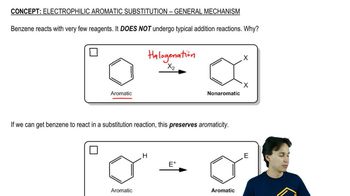
Electrophilic Aromatic Substitution (EAS)

Electrophilic Aromatic Substitution is a fundamental reaction in organic chemistry where an electrophile replaces a hydrogen atom on an aromatic ring. This process typically involves the formation of a sigma complex, where the aromaticity is temporarily lost, followed by deprotonation to restore the aromatic character. Understanding EAS is crucial for predicting the products of reactions involving aromatic compounds like benzene.
Video consigliato:
03:07
EAS Review

Lewis Acids and Bases

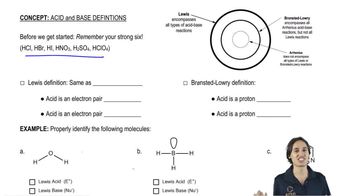
Lewis acids are electron pair acceptors, while Lewis bases are electron pair donors. In the context of the reaction with benzene and aziridines, a Lewis acid like AlCl3 activates the electrophile, enhancing its reactivity towards the aromatic ring. This concept is essential for understanding how the presence of a Lewis acid can facilitate electrophilic aromatic substitution reactions.
Video consigliato:
02:49
The Lewis definition of acids and bases.

Reactivity of Epoxides

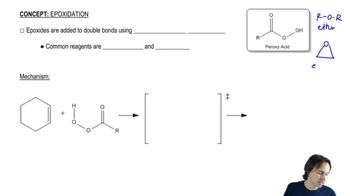
Epoxides are three-membered cyclic ethers that are highly reactive due to the strain in their ring structure. They can undergo nucleophilic attack and other reactions, but their behavior in electrophilic aromatic substitution differs from that of aziridines. Understanding the unique properties of epoxides helps in predicting their reactivity and potential products in similar reactions with aromatic compounds.
Video consigliato:
02:19
General properties of epoxidation.