Ch. 2 - Acids and Bases: Central to Understanding Organic Chemistry
Bruice - Organic Chemistry 8th Edition
Bruice8th EditionOrganic ChemistryISBN: 9780135213711Non è quello che usi tu?Cambia libro di testo
Capitolo 2, Problema 65a

Given the Ka values, estimate the pKa value of each of the following acids without using a calculator (that is, is it between 3 and 4, between 9 and 10, and so on?):
1. nitrous acid (HNO2), Ka = 4.0 × 10⁻⁴
2. nitric acid (HNO3), Ka = 22
3. bicarbonate (HCO3−), Ka = 6.3 × 10⁻¹¹
4. hydrogen cyanide (HCN), Ka = 7.9 × 10⁻¹⁰
5. formic acid (HCOOH), Ka = 2.0 × 10⁻⁴
6. phosphoric acid (H3PO4), Ka = 2.1

Guida verificata passo dopo passo
1
Step 1: Recall the relationship between Ka and pKa. The pKa is calculated using the formula: pKa = -log(Ka). This means that the pKa is the negative logarithm (base 10) of the Ka value.
Step 2: For nitrous acid (HNO2) with Ka = 4.0×10⁻⁴, estimate the pKa. Since the Ka is between 10−4 and 10−3, the pKa will be between 3 and 4. Specifically, because 4.0×10⁻⁴ is closer to 10−4, the pKa will be slightly above 3.
Step 3: For nitric acid (HNO3) with Ka = 22, estimate the pKa. Since the Ka is greater than 1, the pKa will be negative. Specifically, because 22 is close to 101, the pKa will be slightly below -1.
Step 4: For bicarbonate (HCO3−) with Ka = 6.3×10⁻¹¹, estimate the pKa. Since the Ka is between 10−11 and 10−10, the pKa will be between 10 and 11. Specifically, because 6.3×10⁻¹¹ is closer to 10−11, the pKa will be slightly above 10.
Step 5: Repeat the same process for the remaining acids: hydrogen cyanide (HCN) with Ka = 7.9×10⁻¹⁰, formic acid (HCOOH) with Ka = 2.0×10⁻⁴, and phosphoric acid (H3PO4) with Ka = 2.1. Use the same logic to estimate their pKa values based on the range of their Ka values.

Risposta video verificata per un problema simile:

Questa soluzione video è stata consigliata dai nostri tutor come utile per risolvere questo problema.
Durata del video:
10m

Concetti chiave

Ecco i concetti essenziali che devi comprendere per rispondere correttamente alla domanda.

Acid Dissociation Constant (Ka)

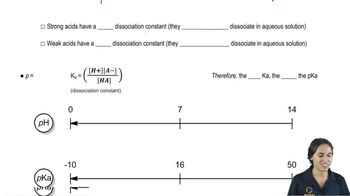
The acid dissociation constant (Ka) quantifies the strength of an acid in solution. It is defined as the equilibrium constant for the dissociation of an acid into its conjugate base and a proton. A higher Ka value indicates a stronger acid, as it dissociates more completely in water. Understanding Ka is essential for estimating pKa values, which are derived from the negative logarithm of Ka.
Video consigliato:
02:19
The relationship between equilibrium constant and pKa.

pKa and its Relationship to Ka

pKa is a logarithmic scale used to express the acidity of a substance, calculated as pKa = -log(Ka). This transformation allows for easier comparison of acid strengths, as lower pKa values correspond to stronger acids. Estimating pKa values without a calculator involves recognizing the order of magnitude of Ka values and their corresponding pKa ranges, which helps in categorizing acids based on their strength.
Video consigliato:
07:45
Identifying pKa values

Estimating pKa Values

Estimating pKa values involves understanding the logarithmic relationship between pKa and Ka. For example, a Ka of 1.0 indicates a pKa of 0, while a Ka of 0.1 corresponds to a pKa of 1. By recognizing that each factor of ten in Ka corresponds to a change of one in pKa, one can approximate pKa values by identifying the range in which the Ka falls. This skill is crucial for quickly assessing acid strength in organic chemistry.
Video consigliato:
07:45
Identifying pKa values