Ch. 2 - Acids and Bases: Central to Understanding Organic Chemistry
Bruice - Organic Chemistry 8th Edition
Bruice8th EditionOrganic ChemistryISBN: 9780135213711Non è quello che usi tu?Cambia libro di testo
Capitolo 2, Problema 76a

If an acid with a pKa of 5.3 is in an aqueous solution of pH 5.7, what percentage of the acid is present in its acidic form?

Guida verificata passo dopo passo
1
Identify the relationship between pH, pKa, and the ratio of the acidic form (HA) to the conjugate base (A⁻) using the Henderson-Hasselbalch equation: \( \text{pH} = \text{pKa} + \log \left( \frac{[A^-]}{[HA]} \right) \).
Rearrange the Henderson-Hasselbalch equation to solve for the ratio \( \frac{[A^-]}{[HA]} \): \( \frac{[A^-]}{[HA]} = 10^{\text{pH} - \text{pKa}} \).
Substitute the given values for pH (5.7) and pKa (5.3) into the equation: \( \frac{[A^-]}{[HA]} = 10^{5.7 - 5.3} \).
Once the ratio \( \frac{[A^-]}{[HA]} \) is determined, calculate the fraction of the acid in its acidic form (HA) using the formula: \( \text{Fraction of HA} = \frac{1}{1 + \frac{[A^-]}{[HA]}} \).
Convert the fraction of HA into a percentage by multiplying by 100: \( \text{Percentage of HA} = \text{Fraction of HA} \times 100 \).

Risposta video verificata per un problema simile:

Questa soluzione video è stata consigliata dai nostri tutor come utile per risolvere questo problema.
Durata del video:
8m

Concetti chiave

Ecco i concetti essenziali che devi comprendere per rispondere correttamente alla domanda.

pKa and pH Relationship

The pKa of an acid is a measure of its strength, indicating the pH at which half of the acid is dissociated. A lower pKa value means a stronger acid. The pH of a solution reflects the concentration of hydrogen ions; when pH is higher than pKa, the acid is more likely to be in its deprotonated (conjugate base) form.
Video consigliato:
07:45
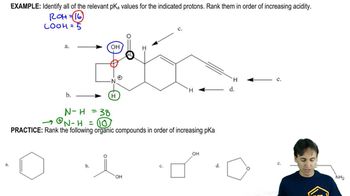
Identifying pKa values

Henderson-Hasselbalch Equation

The Henderson-Hasselbalch equation relates pH, pKa, and the ratio of the concentrations of the deprotonated and protonated forms of an acid. It is expressed as pH = pKa + log([A-]/[HA]), where [A-] is the concentration of the conjugate base and [HA] is the concentration of the acid. This equation is essential for calculating the proportions of the acid in different forms at a given pH.
Video consigliato:
05:02
Breaking down the different terms of the Gibbs Free Energy equation.

Percentage of Acidic Form

To determine the percentage of an acid present in its acidic form, one can use the ratio derived from the Henderson-Hasselbalch equation. By calculating the ratio of [HA] to the total concentration of acid ([HA] + [A-]), the percentage of the acid in its protonated form can be expressed as ( [HA] / ([HA] + [A-]) ) × 100%. This calculation is crucial for understanding the acid's behavior in solution.
Video consigliato:
03:23
How to solve for the percentage of each enantiomer.