Ch. 2 - Acids and Bases: Central to Understanding Organic Chemistry
Bruice - Organic Chemistry 8th Edition
Bruice8th EditionOrganic ChemistryISBN: 9780135213711Non è quello che usi tu?Cambia libro di testo
Capitolo 2, Problema 62a

Rank the following alcohols from strongest to weakest acid.
CH2═CHCH2OH; CH3CH2CH2OH; HC≡CCH2OH

Guida verificata passo dopo passo
1
Step 1: Recall that the acidity of alcohols is influenced by the stability of the conjugate base formed after deprotonation. A more stable conjugate base corresponds to a stronger acid.
Step 2: Analyze the conjugate bases of the given alcohols. For CH2═CHCH2OH, the conjugate base is CH2═CHCH2O⁻. The presence of the vinyl group (CH2═CH-) can stabilize the conjugate base through resonance effects.
Step 3: For CH3CH2CH2OH, the conjugate base is CH3CH2CH2O⁻. This is a simple alkoxide ion without any resonance or inductive effects to stabilize it, making it less stable compared to the conjugate base of CH2═CHCH2OH.
Step 4: For HC≡CCH2OH, the conjugate base is HC≡CCH2O⁻. The presence of the alkyne group (HC≡C-) can exert an inductive effect, pulling electron density away from the oxygen atom and stabilizing the conjugate base.
Step 5: Rank the alcohols based on the stability of their conjugate bases: HC≡CCH2OH (strongest acid due to inductive effect) > CH2═CHCH2OH (moderate acid due to resonance stabilization) > CH3CH2CH2OH (weakest acid due to lack of stabilization).

Risposta video verificata per un problema simile:

Questa soluzione video è stata consigliata dai nostri tutor come utile per risolvere questo problema.
Durata del video:
5m

Concetti chiave

Ecco i concetti essenziali che devi comprendere per rispondere correttamente alla domanda.

Acidity of Alcohols

The acidity of alcohols is determined by the stability of their conjugate bases after deprotonation. Alcohols can donate a proton (H+) to form an alkoxide ion, and the more stable the alkoxide, the stronger the acid. Factors influencing acidity include the electronegativity of the atoms attached to the hydroxyl group and the overall molecular structure.
Video consigliato:
02:02
Forming alcohols through Acid-Catalyzed Hydration.

Inductive Effect

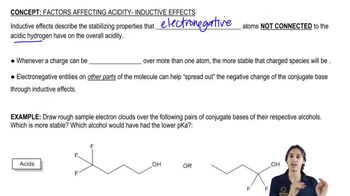
The inductive effect refers to the electron-withdrawing or electron-donating effects of substituents on a molecule. In alcohols, electron-withdrawing groups can stabilize the negative charge on the conjugate base, enhancing acidity. For example, alkyl groups are electron-donating, which can decrease acidity, while groups like halogens can increase it.
Video consigliato:
01:47
Understanding the Inductive Effect.

Hybridization and Acidity

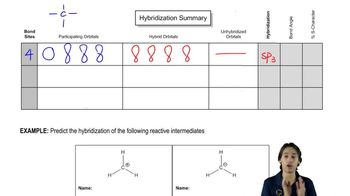
The hybridization of the carbon atom bonded to the hydroxyl group affects the acidity of alcohols. sp-hybridized carbons (like in HC≡CCH2OH) are more electronegative than sp2 or sp3 hybridized carbons, leading to a more stable conjugate base. Thus, alcohols with sp-hybridized carbons tend to be stronger acids compared to those with sp2 or sp3 hybridization.
Video consigliato:
10:43
Using bond sites to predict hybridization