Ch. 2 - Acids and Bases: Central to Understanding Organic Chemistry
Bruice - Organic Chemistry 8th Edition
Bruice8th EditionOrganic ChemistryISBN: 9780135213711Non è quello che usi tu?Cambia libro di testo
Capitolo 2, Problema 72a

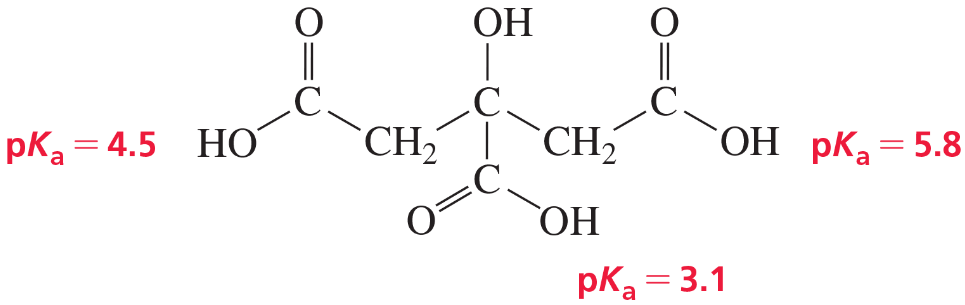
Citrus fruits are rich in citric acid, a compound with three COOH groups. Explain the following:
a. The first pKa (for the COOH group in the center of the molecule) is lower than the pKa of acetic acid.

Guida verificata passo dopo passo
1
Identify the structure of citric acid from the image. Citric acid contains three carboxylic acid (COOH) groups, with pKa values labeled as 3.1, 4.5, and 5.8. The central COOH group has the lowest pKa (3.1), indicating it is the most acidic.
Understand the concept of pKa. The pKa value is inversely related to the acidity of a compound; a lower pKa means the compound is more acidic. Acetic acid, for comparison, has a pKa of approximately 4.76.
Analyze the electronic environment of the central COOH group. The central COOH group is surrounded by two other carboxylic acid groups. These groups are electron-withdrawing due to their electronegative oxygen atoms, which stabilize the negative charge on the conjugate base formed after deprotonation.
Explain the inductive effect. The electron-withdrawing nature of the adjacent COOH groups increases the acidity of the central COOH group by stabilizing its conjugate base. This effect is stronger for the central COOH group compared to acetic acid, which has no such electron-withdrawing groups nearby.
Conclude that the lower pKa of the central COOH group in citric acid compared to acetic acid is due to the inductive effect of the neighboring carboxylic acid groups, which enhance the acidity of the central COOH group.

Risposta video verificata per un problema simile:

Questa soluzione video è stata consigliata dai nostri tutor come utile per risolvere questo problema.
Durata del video:
6m

Concetti chiave

Ecco i concetti essenziali che devi comprendere per rispondere correttamente alla domanda.

Acidity and pKa

The pKa value is a measure of the acidity of a compound, indicating the strength of an acid in solution. A lower pKa value signifies a stronger acid, meaning it dissociates more readily to release protons (H+). In the context of citric acid, the presence of multiple COOH groups can influence its overall acidity compared to simpler acids like acetic acid.
Video consigliato:
07:45
Identifying pKa values

Structural Effects on Acidity

The structure of a molecule significantly affects its acidity. In citric acid, the arrangement of the three carboxylic acid (COOH) groups can create intramolecular interactions that stabilize the negative charge on the conjugate base after deprotonation. This stabilization can lead to a lower pKa for the central COOH group compared to acetic acid, which has only one COOH group.
Video consigliato:
Percorso guidato
1:05
Citric Acid Cycle Structures Concept 1

Comparative Acidity of Carboxylic Acids

When comparing carboxylic acids, factors such as electronegativity, resonance, and inductive effects play crucial roles in determining acidity. Citric acid, with its multiple COOH groups, exhibits stronger electron-withdrawing effects and resonance stabilization in its conjugate base, making it more acidic than acetic acid, which lacks these additional stabilizing features.
Video consigliato:
04:20
Carboxylic Acids Nomenclature