


Ch. 20 - The Organic Chemistry of Carbohydrates
Bruice - Organic Chemistry 8th Edition
Bruice8th EditionOrganic ChemistryISBN: 9780135213711Non è quello che usi tu?Cambia libro di testo
Capitolo 20, Problema 67

Draw the mechanism for the elimination step in the Wohl degredation.

Guida verificata passo dopo passo
1
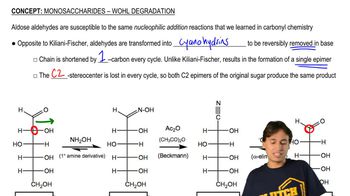
Understand the Wohl degradation: It is a reaction used to shorten an aldose sugar by one carbon atom. The elimination step involves the removal of hydrogen cyanide (HCN) from an intermediate imine compound.
Identify the intermediate: The intermediate in the Wohl degradation is an imine formed by the reaction of the aldose sugar with hydroxylamine (NH2OH) and subsequent dehydration. This imine is then treated with a base to initiate the elimination step.
Deprotonation step: A strong base (e.g., NaOH or KOH) deprotonates the hydrogen atom on the carbon adjacent to the imine group, forming a carbanion. This step is crucial for initiating the elimination process.
Formation of a double bond: The carbanion formed in the previous step donates its lone pair of electrons to form a double bond between the carbon and nitrogen atoms, leading to the elimination of the cyanide ion (CN⁻).
Final product: The elimination step results in the formation of an aldose sugar with one fewer carbon atom, along with the release of HCN as a byproduct. Ensure to draw the structure of the shortened aldose sugar and the eliminated HCN.

Risposta video verificata per un problema simile:

Questa soluzione video è stata consigliata dai nostri tutor come utile per risolvere questo problema.
Durata del video:
3m

Concetti chiave

Ecco i concetti essenziali che devi comprendere per rispondere correttamente alla domanda.

Wohl Degradation

The Wohl degradation is a chemical reaction that involves the conversion of a sugar into a smaller sugar through a series of reactions, including oxidation and elimination. This process is particularly important in organic chemistry for understanding carbohydrate chemistry and the manipulation of sugar structures. The reaction typically starts with the formation of an intermediate that undergoes elimination to yield the final product.
Video consigliato:
09:43
Monosaccharides - Wohl Degradation

Elimination Reactions

Elimination reactions are a class of organic reactions where two substituents are removed from a molecule, resulting in the formation of a double bond or a ring structure. In the context of the Wohl degradation, the elimination step involves the removal of a leaving group and a hydrogen atom, leading to the formation of a double bond. Understanding the mechanisms of elimination reactions, such as E1 and E2 pathways, is crucial for predicting the products of these reactions.
Video consigliato:
00:40
Recognizing Elimination Reactions.

Reaction Mechanism

A reaction mechanism is a step-by-step description of the process by which reactants are converted into products in a chemical reaction. It outlines the sequence of elementary steps, including bond breaking and formation, and provides insight into the transition states and intermediates involved. For the Wohl degradation, drawing the mechanism requires knowledge of the specific steps involved in the elimination process, including the formation of intermediates and the final product.
Video consigliato:
02:16
Heck Reaction Mechanism
Pratica correlata
Domanda del libro di testo

An unknown disaccharide gives a positive Tollens' test. A glycosidase hydrolyzes it to D-galactose and D-mannose. When the disaccharide is treated with methyl iodide and Ag2O and then hydrolyzed with dilute HCl, the products are 2,3,4,6-tetra-O-methylgalactose and 2,3,4-tri-O-methylmannose. Propose a structure for the disaccharide.

1728
views
Domanda del libro di testo

Trehalose, C12H22O11, is a nonreducing sugar that is only 45% as sweet as sugar. When hydrolyzed by aqueous acid or the enzyme maltase, it forms only D-glucose. When it is treated with excess methyl iodide in the presence of Ag2O and then hydrolyzed with water under acidic conditions, only 2,3,4,6-tetra-O-methyl-d-glucose is formed. Draw the structure of trehalose.

1176
views
Domanda del libro di testo

The specific rotation of α-D-galactose is 150.7 and that of β-D-galactose is 52.8. When an aqueous mixture that was initially 70% α-D-galactose and 30% β-D-galactose reaches equilibrium, the specific rotation is 80.2. What is the percentage of α-D-galactose and β-D galactose at equilibrium?

1174
views
Domanda del libro di testo

Predict whether D-altrose exists preferentially as a pyranose or a furanose. (Hint: In the most stable arrangement for a five-membered ring, all the adjacent substituents are trans.)

813
views
Domanda del libro di testo

Draw each of the following:

a. β-D-talopyranose

b. α-D-idopyranose  

790
views
Domanda del libro di testo

Calculate the percentages of α\(\alpha\)-D-glucose and β\(\beta\)-D-glucose present at equilibrium from the specific rotations of α\(\alpha\)-D-glucose, β\(\beta\)-D-glucose, and the equilibrium mixture. Compare your values with those given in Section 20.10. (Hint: The specific rotation of the mixture equals the specific rotation of α\(\alpha\)-D-glucose times the fraction of glucose present in the a-form plus the specific rotation of β\(\beta\)-D-glucose times the fraction of glucose present in the β\(\beta\) -form.)

1029
views