Ch. 20 - The Organic Chemistry of Carbohydrates
Bruice - Organic Chemistry 8th Edition
Bruice8th EditionOrganic ChemistryISBN: 9780135213711Non è quello che usi tu?Cambia libro di testo
Capitolo 20, Problema 44

Treatment with sodium borohydride converts aldose A to an optically inactive alditol. Wohl degradation of A forms B, whose alditol is optically inactive. Wohl degradation of B forms D-glyceraldehyde. Identify A and B.

Guida verificata passo dopo passo
1
Step 1: Understand the problem. Sodium borohydride (NaBH₄) reduces aldoses to alditols by converting the aldehyde group (-CHO) into a primary alcohol (-CH₂OH). The fact that the alditol of A is optically inactive suggests that A is a meso compound, meaning it has internal symmetry and no net optical activity.
Step 2: Perform the first Wohl degradation. Wohl degradation involves converting an aldose into a smaller aldose by removing the terminal carbon atom as hydrogen cyanide (HCN). The fact that the alditol of B is also optically inactive suggests that B is also a meso compound.
Step 3: Perform the second Wohl degradation. The problem states that the second Wohl degradation of B produces d-glyceraldehyde. This is a key clue because d-glyceraldehyde is the simplest aldose with a single chiral center, and it is optically active.
Step 4: Work backward to identify B. Since B undergoes Wohl degradation to form d-glyceraldehyde, B must be a four-carbon aldose (aldotetrose) with internal symmetry. The only meso aldotetrose is erythrose, which has two chiral centers and internal symmetry.
Step 5: Work backward to identify A. Since A undergoes Wohl degradation to form B (erythrose), A must be a five-carbon aldose (aldopentose) with internal symmetry. The only meso aldopentose is ribose. Therefore, A is ribose, and B is erythrose.

Risposta video verificata per un problema simile:

Questa soluzione video è stata consigliata dai nostri tutor come utile per risolvere questo problema.
Durata del video:
11m

Concetti chiave

Ecco i concetti essenziali che devi comprendere per rispondere correttamente alla domanda.

Aldoses and Alditols

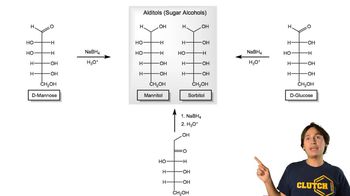
Aldoses are a type of monosaccharide that contain an aldehyde group, while alditols are sugar alcohols formed by the reduction of aldoses. The conversion of an aldose to an alditol typically involves the addition of hydrogen to the carbonyl group, resulting in a compound that lacks optical activity if it has a symmetrical structure.
Video consigliato:
07:19
Monosaccharides - Reduction (Alditols)

Wohl Degradation

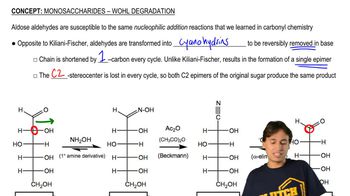
Wohl degradation is a chemical reaction that involves the oxidative cleavage of aldoses to produce smaller aldehydes or ketones. This process is significant in carbohydrate chemistry as it allows for the identification and transformation of sugars, leading to the formation of simpler sugars like d-glyceraldehyde from more complex aldoses.
Video consigliato:
09:43
Monosaccharides - Wohl Degradation

Optical Activity

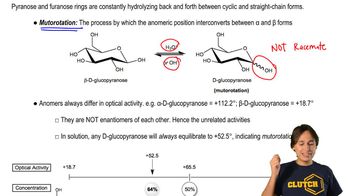
Optical activity refers to the ability of a compound to rotate plane-polarized light, which is a characteristic of chiral molecules. A compound is optically inactive if it is either achiral or if it contains a plane of symmetry, resulting in equal contributions to light rotation from its enantiomers. Understanding optical activity is crucial for identifying the stereochemistry of sugars and their derivatives.
Video consigliato:
08:17
Mutarotation and Optical Activity