Ch. 21 - Amino Acids, Peptides, and Proteins
Bruice - Organic Chemistry 8th Edition
Bruice8th EditionOrganic ChemistryISBN: 9780135213711Non è quello che usi tu?Cambia libro di testo
Capitolo 21, Problema 24b

What amino acid is formed when the aldehyde used in the Strecker synthesis is
b. 2-methylbutanal?

Guida verificata passo dopo passo
1
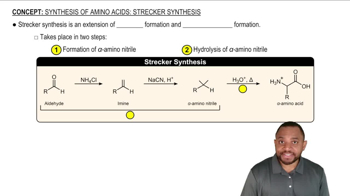
The Strecker synthesis is a method for synthesizing α-amino acids by reacting an aldehyde with ammonium chloride (NH₄Cl) and potassium cyanide (KCN). The process involves the formation of an imine intermediate, followed by cyanide addition and hydrolysis.
Identify the aldehyde provided in the problem: 2-methylbutanal. Its structure consists of a four-carbon chain with a methyl group attached to the second carbon and an aldehyde functional group (-CHO) at the terminal carbon.
In the first step of the Strecker synthesis, the aldehyde (2-methylbutanal) reacts with ammonium chloride (NH₄Cl) and forms an imine intermediate through a condensation reaction. This imine has the general structure R-CH=NH, where R represents the 2-methylbutyl group.
Next, potassium cyanide (KCN) reacts with the imine intermediate. The cyanide ion (CN⁻) adds to the carbon atom of the imine, forming an α-aminonitrile intermediate. The structure of this intermediate will have the 2-methylbutyl group, an amino group (-NH₂), and a nitrile group (-C≡N) attached to the same carbon.
Finally, the α-aminonitrile undergoes hydrolysis under acidic conditions. The nitrile group (-C≡N) is converted into a carboxylic acid group (-COOH), resulting in the formation of the α-amino acid. The amino acid formed will have the 2-methylbutyl group as its side chain, making it isoleucine.

Risposta video verificata per un problema simile:

Questa soluzione video è stata consigliata dai nostri tutor come utile per risolvere questo problema.
Durata del video:
5m

Concetti chiave

Ecco i concetti essenziali che devi comprendere per rispondere correttamente alla domanda.

Strecker Synthesis

Strecker synthesis is a method for producing amino acids from aldehydes or ketones. It involves the reaction of an aldehyde with ammonia and hydrogen cyanide, leading to the formation of an α-amino nitrile intermediate, which can be hydrolyzed to yield the corresponding amino acid. Understanding this process is crucial for determining the specific amino acid produced from a given aldehyde.
Video consigliato:
Percorso guidato
1:39
Synthesis of Amino Acids: Strecker Synthesis Concept 1

Amino Acid Structure

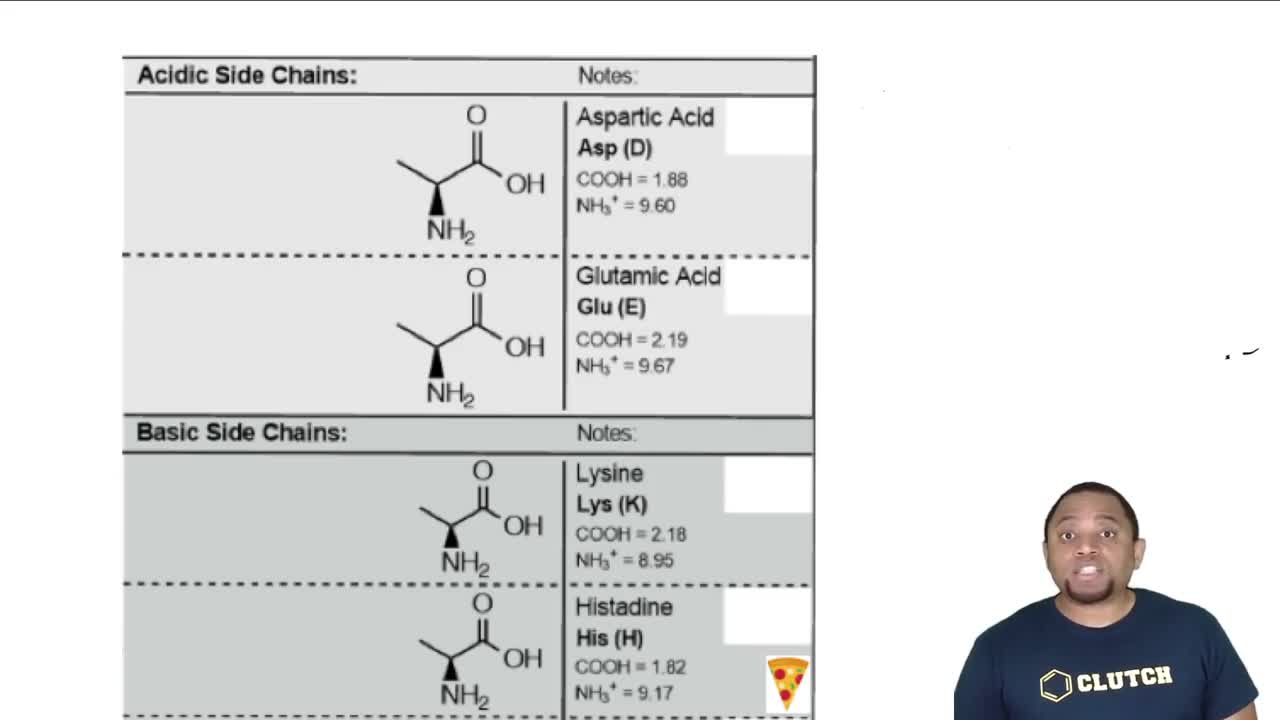
Amino acids are organic compounds characterized by the presence of both an amino group (-NH2) and a carboxyl group (-COOH), along with a unique side chain (R group) that determines the properties of the amino acid. The structure of the amino acid formed in the Strecker synthesis will depend on the aldehyde used, in this case, 2-methylbutanal, which influences the resulting side chain and overall identity of the amino acid.
Video consigliato:
7:19
Charged Amino Acids

Aldehyde Reactivity

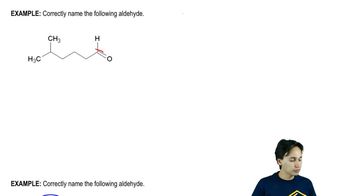
Aldehydes are reactive carbonyl compounds that can undergo various chemical reactions, including nucleophilic addition. In the context of Strecker synthesis, the aldehyde reacts with ammonia and cyanide to form an amino nitrile. The specific structure of the aldehyde, such as 2-methylbutanal, affects the final amino acid product, making it essential to understand how different aldehydes influence reactivity and product formation.
Video consigliato:
01:34
Name the aldehyde