


Ch. 22 - Catalysis in Organic Reactions and in Enzymatic Reactions
Bruice - Organic Chemistry 8th Edition
Bruice8th EditionOrganic ChemistryISBN: 9780135213711Non è quello che usi tu?Cambia libro di testo
Capitolo 22, Problema 35

Co2+ catalyzes the hydrolysis of the lactam shown here. Propose a mechanism for the metal-ion catalyzed reaction.

Guida verificata passo dopo passo
1
Identify the structure of the lactam. A lactam is a cyclic amide, so the molecule contains a nitrogen atom in the ring bonded to a carbonyl group (C=O). This will be the starting point for the reaction mechanism.
Recognize the role of the Co²⁺ ion. Metal ions like Co²⁺ often act as Lewis acids, meaning they can accept electron pairs. In this case, Co²⁺ will coordinate with the carbonyl oxygen of the lactam, increasing the electrophilicity of the carbonyl carbon.
Propose the nucleophilic attack. The increased electrophilicity of the carbonyl carbon makes it more susceptible to nucleophilic attack by water (H₂O). Water will act as a nucleophile, attacking the carbonyl carbon and forming a tetrahedral intermediate.
Account for proton transfer. After the nucleophilic attack, a proton transfer occurs to stabilize the intermediate. This step may involve the assistance of the Co²⁺ ion or surrounding water molecules to facilitate the transfer.
Describe the breakdown of the intermediate. The tetrahedral intermediate collapses, breaking the C-N bond in the lactam ring. This results in the formation of a carboxylic acid and an amine as the final products of the hydrolysis reaction.

Risposta video verificata per un problema simile:

Questa soluzione video è stata consigliata dai nostri tutor come utile per risolvere questo problema.
Durata del video:
3m

Concetti chiave

Ecco i concetti essenziali che devi comprendere per rispondere correttamente alla domanda.

Lactam Hydrolysis

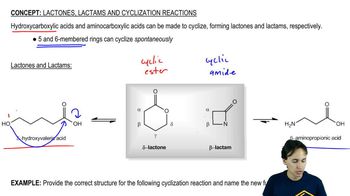
Lactams are cyclic amides that can undergo hydrolysis, a reaction where water breaks the amide bond, leading to the formation of a carboxylic acid and an amine. Understanding the structure of lactams and the conditions under which hydrolysis occurs is crucial for proposing a mechanism. The presence of a catalyst can significantly lower the activation energy required for this reaction.
Video consigliato:
05:19
Lactones and Lactams

Metal-Ion Catalysis

Metal-ion catalysis involves the use of metal ions to enhance the rate of a chemical reaction. In the context of lactam hydrolysis, metal ions can stabilize transition states or intermediates, making the reaction more favorable. This concept is essential for understanding how metal ions interact with substrates and facilitate bond cleavage during the hydrolysis process.
Video consigliato:
Percorso guidato
3:39
Metal Ion Catalysis Concept 1

Reaction Mechanism

A reaction mechanism describes the step-by-step sequence of elementary reactions that lead to the overall transformation of reactants into products. Proposing a mechanism for the metal-ion catalyzed hydrolysis of a lactam requires knowledge of the intermediates formed, the role of the catalyst, and the specific steps involved in bond breaking and formation. This understanding is vital for accurately depicting how the reaction proceeds.
Video consigliato:
02:16
Heck Reaction Mechanism
Pratica correlata
Domanda del libro di testo

Carbonic anhydrase is an enzyme that catalyzes the conversion of carbon dioxide to bicarbonate ion. It is a metalloenzyme, with Zn2+ coordinated at the active site by three histidine side chains. Propose a mechanism for the reaction.

134
views
Domanda del libro di testo

Propose a mechanism for the following reaction. (Hint: The rate of the reaction is much slower if the nitrogen atom is replaced by CH.)

1136
views
Domanda del libro di testo

The rate constant for the uncatalyzed reaction of two molecules of glycine ethyl ester to form glycylglycine ethyl ester is 0.6 M-1 s-1. In the presence of Co2+, the rate constant is 1.5 × 10⁶ M-1 s-1. What rate enhancement does the catalyst provide?

1058
views
Domanda del libro di testo

The deuterium kinetic isotope effect (kH2O/kD2O) for the hydrolysis of aspirin is 2.2. What does this tell you about the kind of catalysis exerted by the ortho-carboxyl substituent? (Hint: It is easier to break an O–H bond than an O–D bond.)

74
views
Domanda del libro di testo

Indicate the type of catalysis that is occurring in the slow step in each of the following reaction sequences:

b.

725
views
Domanda del libro di testo

2-Acetoxycyclohexyl tosylate reacts with acetate ion to form 1,2-cyclohexanediol diacetate. The reaction is stereospecific—that is, the stereoisomers obtained as products depend on the stereoisomer used as a reactant. Recall that because 2-acetoxycyclohexyl tosylate has two asymmetric centers, it has four stereoisomers—two are cis and two are trans. Explain the following observations:

a. Both cis reactants form an optically active trans product, but each cis reactant forms a different trans product.

2114
views