Ch. 22 - Catalysis in Organic Reactions and in Enzymatic Reactions
Bruice - Organic Chemistry 8th Edition
Bruice8th EditionOrganic ChemistryISBN: 9780135213711Non è quello che usi tu?Cambia libro di testo
Capitolo 22, Problema 24

Draw the mechanism for the hydroxide ion–catalyzed cleavage of fructose-1,6-bisphosphate.

Guida verificata passo dopo passo
1
Identify the structure of fructose-1,6-bisphosphate. It is a six-carbon sugar with phosphate groups attached to the first and sixth carbons. The molecule contains a ketone functional group at the second carbon and hydroxyl groups on the remaining carbons.
Recognize that the reaction is catalyzed by hydroxide ions (OH⁻), which act as a nucleophile. Hydroxide ions will attack the electrophilic carbonyl carbon of the ketone group in fructose-1,6-bisphosphate.
Draw the nucleophilic attack of the hydroxide ion on the carbonyl carbon of the ketone group. This forms a tetrahedral intermediate, where the carbonyl oxygen becomes negatively charged.
Illustrate the breakdown of the tetrahedral intermediate. The negatively charged oxygen reforms the carbonyl group, leading to the cleavage of the C3-C4 bond. This results in the formation of two products: dihydroxyacetone phosphate (DHAP) and glyceraldehyde-3-phosphate (G3P).
Show the stabilization of the products. Both DHAP and G3P are stabilized by resonance and the presence of phosphate groups, which help to delocalize the negative charge. Ensure the final structures of the products are clearly drawn with proper stereochemistry and functional groups.

Risposta video verificata per un problema simile:

Questa soluzione video è stata consigliata dai nostri tutor come utile per risolvere questo problema.
Durata del video:
6m

Concetti chiave

Ecco i concetti essenziali che devi comprendere per rispondere correttamente alla domanda.

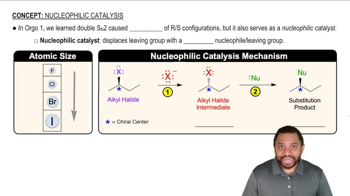
Enzyme Catalysis

Enzyme catalysis involves the acceleration of chemical reactions by enzymes, which are biological catalysts. In the context of fructose-1,6-bisphosphate cleavage, enzymes like aldolase facilitate the reaction by lowering the activation energy, allowing the reaction to proceed more efficiently. Understanding how enzymes interact with substrates is crucial for grasping the mechanism of this reaction.
Video consigliato:
Percorso guidato
2:31
Nucleophilic Catalysis Concept 1

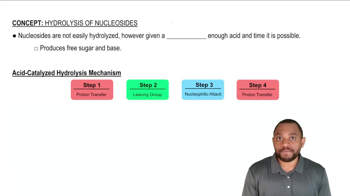
Mechanism of Hydrolysis

The mechanism of hydrolysis refers to the chemical process where water is used to break down a compound. In the case of fructose-1,6-bisphosphate, hydroxide ions act as nucleophiles, attacking the carbonyl carbon of the phosphate group, leading to the cleavage of the molecule. Familiarity with nucleophilic attack and the role of water in hydrolysis is essential for understanding this reaction.
Video consigliato:
Percorso guidato
0:55
Hydrolysis of Nucleosides Concept 1

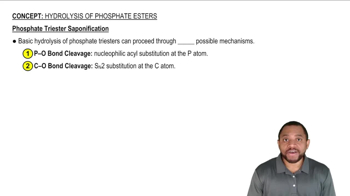
Phosphate Group Cleavage

Phosphate group cleavage is a critical reaction in biochemistry, where a phosphate group is removed from a molecule, often releasing energy. In the cleavage of fructose-1,6-bisphosphate, the breaking of the phosphate bond is a key step that leads to the formation of two three-carbon molecules. Recognizing the significance of phosphate groups in metabolic pathways is vital for comprehending the overall reaction.
Video consigliato:
Percorso guidato
0:48
Hydrolysis of Phosphate Esters Concept 2