
Ch. 28 - Pericyclic Reactions
Bruice - Organic Chemistry 8th Edition
Bruice8th EditionOrganic ChemistryISBN: 9780135213711Non è quello che usi tu?Cambia libro di testo
Capitolo 24, Problema 12a(4)

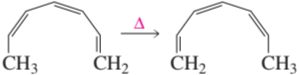
a. Name the kind of sigmatropic rearrangement that occurs in each of the following reactions.
4. Illustration of a sigmatropic rearrangement reaction with reactants and products labeled, featuring a heat symbol.

Guida verificata passo dopo passo
1
Step 1: Understand the concept of sigmatropic rearrangements. These are pericyclic reactions where a sigma bond adjacent to one or more π systems migrates to a new position, with the π system reorganizing itself. The reaction is classified as [m,n], where m and n represent the number of atoms in the two fragments involved in the rearrangement.
Step 2: Analyze the structure of the starting material and the product. Identify the sigma bond that is breaking and the new sigma bond that is forming. Count the number of atoms in the two fragments (m and n) to determine the type of rearrangement.
Step 3: Check for common types of sigmatropic rearrangements, such as the [1,3]-hydride shift, [1,5]-hydride shift, [3,3]-Claisen rearrangement, or [3,3]-Cope rearrangement. Match the observed changes in the molecule to one of these known rearrangements.
Step 4: Verify the reaction mechanism. Ensure that the rearrangement follows the rules of orbital symmetry and conservation of aromaticity (if applicable). This step confirms that the reaction is thermally allowed under the Woodward-Hoffmann rules.
Step 5: Assign the name of the sigmatropic rearrangement based on the analysis. For example, if the reaction involves a [3,3] shift, it could be a Claisen or Cope rearrangement depending on the functional groups involved.

Risposta video verificata per un problema simile:

Questa soluzione video è stata consigliata dai nostri tutor come utile per risolvere questo problema.
Durata del video:
4m

Concetti chiave

Ecco i concetti essenziali che devi comprendere per rispondere correttamente alla domanda.

Sigmatropic Rearrangement

Sigmatropic rearrangements are a class of pericyclic reactions where a sigma bond and a π bond are rearranged in a concerted manner. These reactions involve the migration of a substituent across a σ-bond, leading to the formation of new bonds and the reorganization of the molecular structure. Understanding the mechanism and the types of sigmatropic rearrangements is crucial for predicting the products of such reactions.
Video consigliato:
03:20
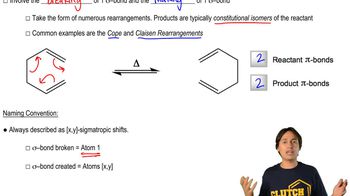
Nomenclature of Sigmatropic Shifts

Types of Sigmatropic Rearrangements

Sigmatropic rearrangements are categorized based on the number of atoms involved in the migration. The most common types are [1,3]- and [1,5]-sigmatropic rearrangements, where the numbers indicate the positions of the migrating atoms. Each type has distinct characteristics and stereochemical outcomes, which are essential for identifying the specific rearrangement occurring in a given reaction.
Video consigliato:
03:20
Nomenclature of Sigmatropic Shifts

Woodward-Hoffmann Rules

The Woodward-Hoffmann rules provide a framework for predicting the stereochemical outcomes of pericyclic reactions, including sigmatropic rearrangements. These rules are based on the conservation of orbital symmetry and help determine whether a reaction will proceed under thermal or photochemical conditions. Familiarity with these rules is vital for understanding the feasibility and selectivity of sigmatropic rearrangements.
Video consigliato:
Percorso guidato
1:18
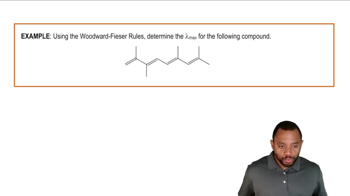
Woodward-Fieser Rules Example 1