Ch. 3 - An Introduction to Organic Compounds: Nomenclature, Physical Properties, and Structure
Bruice - Organic Chemistry 8th Edition
Bruice8th EditionOrganic ChemistryISBN: 9780135213711Non è quello che usi tu?Cambia libro di testo
Capitolo 3, Problema 54b

What is the energy difference between the two chair conformers of cis-1,4-dimethylcyclohexane?

Guida verificata passo dopo passo
1
Identify the two chair conformations of cis-1,4-dimethylcyclohexane. In the cis configuration, both methyl groups are on the same side of the cyclohexane ring. This means one methyl group will be axial and the other equatorial in one chair conformation, and the positions will switch in the other chair conformation.
Determine the steric strain associated with each conformation. The axial methyl group in each conformation will experience 1,3-diaxial interactions, which contribute to steric strain. Use the standard energy value for a methyl group in the axial position (approximately 7.6 kJ/mol or 1.8 kcal/mol per methyl group).
Calculate the total steric strain for each chair conformation. In one conformation, the axial methyl group contributes to the steric strain, while the equatorial methyl group does not. In the other conformation, the positions of the methyl groups are reversed, so the steric strain will be the same.
Compare the steric strain of the two conformations. Since the steric strain is the same in both conformations (one axial and one equatorial methyl group in each), the energy difference between the two chair conformers is zero.
Conclude that for cis-1,4-dimethylcyclohexane, the two chair conformers are equally stable because the steric strain is identical in both conformations.

Risposta video verificata per un problema simile:

Questa soluzione video è stata consigliata dai nostri tutor come utile per risolvere questo problema.
Durata del video:
6m

Concetti chiave

Ecco i concetti essenziali che devi comprendere per rispondere correttamente alla domanda.

Chair Conformation

Chair conformation is the most stable arrangement of cyclohexane rings, minimizing steric strain and torsional strain. In this conformation, carbon atoms adopt a staggered arrangement, allowing for optimal bond angles and reducing interactions between substituents. Understanding chair conformations is crucial for analyzing the stability of substituted cyclohexanes, such as cis-1,4-dimethylcyclohexane.
Video consigliato:
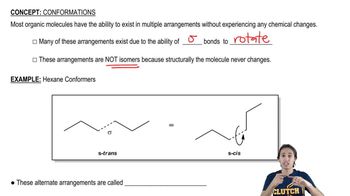
03:29
Understanding what a conformer is.

Steric Strain

Steric strain arises when atoms are forced closer together than their atomic radii allow, leading to increased energy and instability. In the context of cyclohexane derivatives, substituents can experience steric interactions depending on their positions (axial or equatorial) in the chair conformation. Evaluating steric strain is essential for determining the energy difference between conformers.
Video consigliato:
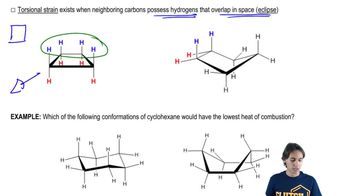
02:00
What is torsional strain?

Equatorial vs. Axial Position

In chair conformations, substituents can occupy either equatorial or axial positions. Equatorial positions are generally more stable as they minimize steric interactions with other axial substituents on the same side of the ring. For cis-1,4-dimethylcyclohexane, analyzing the positions of the methyl groups helps predict the more stable conformer and calculate the energy difference between the two chair forms.
Video consigliato:
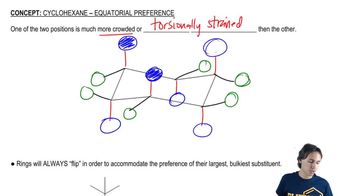
04:02
Equatorial Preference