Ch. 3 - An Introduction to Organic Compounds: Nomenclature, Physical Properties, and Structure
Bruice - Organic Chemistry 8th Edition
Bruice8th EditionOrganic ChemistryISBN: 9780135213711Non è quello che usi tu?Cambia libro di testo
Capitolo 3, Problema 45

Draw 1,2,3,4,5,6-hexachlorocyclohexane with
a. all the chloro groups in axial positions.
b. all the chloro groups in equatorial positions.

Guida verificata passo dopo passo
1
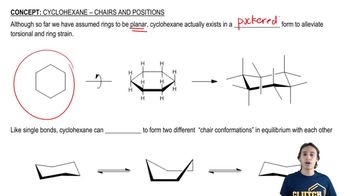
Step 1: Begin by understanding the structure of cyclohexane. Cyclohexane is a six-membered ring that can adopt a chair conformation, which is the most stable conformation. In this conformation, each carbon atom has one axial position (pointing up or down, perpendicular to the ring) and one equatorial position (pointing outward, roughly parallel to the plane of the ring).
Step 2: For part (a), where all chloro groups are in axial positions, identify the six axial positions on the cyclohexane chair conformation. These alternate between pointing up and down around the ring. Place a chlorine atom at each of these axial positions.
Step 3: For part (b), where all chloro groups are in equatorial positions, identify the six equatorial positions on the cyclohexane chair conformation. These alternate between pointing outward and slightly upward or downward around the ring. Place a chlorine atom at each of these equatorial positions.
Step 4: Ensure that the placement of the chloro groups respects the stereochemistry of the chair conformation. Axial positions are perpendicular to the ring, while equatorial positions are angled outward. Double-check that all six chlorine atoms are correctly placed in either axial or equatorial positions as specified in parts (a) and (b).
Step 5: Draw the final structures for both cases. For part (a), the structure will show all chlorine atoms in axial positions, alternating up and down. For part (b), the structure will show all chlorine atoms in equatorial positions, alternating outward and slightly upward or downward. Label the positions clearly to avoid confusion.

Risposta video verificata per un problema simile:

Questa soluzione video è stata consigliata dai nostri tutor come utile per risolvere questo problema.
Durata del video:
4m

Concetti chiave

Ecco i concetti essenziali che devi comprendere per rispondere correttamente alla domanda.

Chair Conformation of Cyclohexane

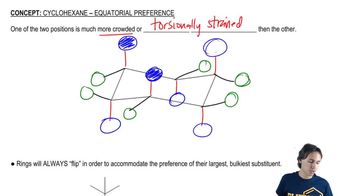
Cyclohexane can adopt a chair conformation that minimizes steric strain. In this conformation, substituents can occupy either axial (pointing up or down) or equatorial (pointing outward) positions. The arrangement of substituents affects the stability of the molecule, with equatorial positions generally being more stable due to reduced steric hindrance.
Video consigliato:
01:05
What is a chair conformation?

Axial vs. Equatorial Substituents

In cyclohexane derivatives, substituents can be positioned axially or equatorially. Axial substituents are aligned parallel to the axis of the ring, while equatorial substituents extend outward from the ring. The choice of position significantly influences the molecule's overall stability and reactivity, as axial substituents can lead to 1,3-diaxial interactions, increasing steric strain.
Video consigliato:
04:02
Equatorial Preference

Stereoisomerism in Substituted Cyclohexanes

Stereoisomerism occurs when compounds have the same molecular formula but differ in the spatial arrangement of atoms. In the case of hexachlorocyclohexane, the positioning of the six chlorine atoms can lead to different stereoisomers, depending on whether they are all in axial or equatorial positions. Understanding these arrangements is crucial for predicting the physical and chemical properties of the compound.
Video consigliato:
01:58
Determining when molecules are stereoisomers.