Ch. 3 - An Introduction to Organic Compounds: Nomenclature, Physical Properties, and Structure
Bruice - Organic Chemistry 8th Edition
Bruice8th EditionOrganic ChemistryISBN: 9780135213711Non è quello che usi tu?Cambia libro di testo
Capitolo 3, Problema 55g

Draw a condensed structure and a skeletal structure for each of the following:
g. 4-(1,1-dimethylethyl)heptane

Guida verificata passo dopo passo
1
Identify the parent chain: The parent chain is 'heptane,' which indicates a straight chain of 7 carbon atoms. Number the chain from one end to the other to ensure the substituent gets the lowest possible number.
Locate the substituent: The substituent is '4-(1,1-dimethylethyl).' This means there is a tert-butyl group (a carbon atom bonded to three methyl groups) attached to the fourth carbon of the heptane chain.
Draw the condensed structure: Start with the heptane chain and add the substituent at the fourth carbon. The condensed structure will show the tert-butyl group as (C(CH3)3) attached to the fourth carbon.
Draw the skeletal structure: Represent the heptane chain as a zigzag line with 7 vertices (each vertex representing a carbon atom). At the fourth vertex, draw a branch representing the tert-butyl group, which consists of a central carbon bonded to three methyl groups.
Double-check the structure: Ensure that the parent chain has 7 carbons, the substituent is correctly placed at the fourth carbon, and all carbons have the correct number of bonds (4 bonds per carbon).

Risposta video verificata per un problema simile:

Questa soluzione video è stata consigliata dai nostri tutor come utile per risolvere questo problema.
Durata del video:
9m

Concetti chiave

Ecco i concetti essenziali che devi comprendere per rispondere correttamente alla domanda.

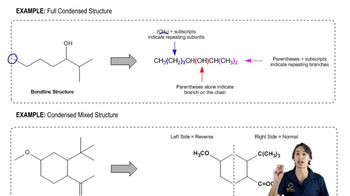
Condensed Structural Formula

A condensed structural formula is a way of representing a chemical compound that shows the arrangement of atoms and the connectivity between them without depicting all the bonds explicitly. In this format, groups of atoms are often grouped together, and hydrogen atoms attached to carbons are usually omitted for simplicity. For example, in 4-(1,1-dimethylethyl)heptane, the condensed structure would reflect the branching and the heptane backbone in a compact form.
Video consigliato:
06:06
How to interpret condensed structures.

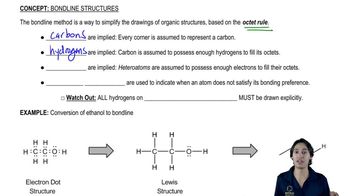
Skeletal Structure

A skeletal structure, also known as a line-angle structure, is a simplified representation of a molecule where carbon atoms are represented by vertices and hydrogen atoms are implied. Bonds between carbon atoms are shown as lines, and functional groups or substituents are depicted as attached to the carbon skeleton. This method allows chemists to visualize complex organic molecules more easily, focusing on the overall shape and connectivity rather than individual atoms.
Video consigliato:
04:03
How bondline is different from Lewis Structures.

Substituents in Organic Chemistry

Substituents are atoms or groups of atoms that replace hydrogen atoms in a hydrocarbon chain, altering the properties and reactivity of the molecule. In the case of 4-(1,1-dimethylethyl)heptane, the '1,1-dimethylethyl' group is a branched substituent that affects the overall structure and physical properties of the heptane backbone. Understanding how to identify and represent substituents is crucial for drawing accurate structural formulas.
Video consigliato:
00:56
What is an organic molecule?