Ch. 3 - An Introduction to Organic Compounds: Nomenclature, Physical Properties, and Structure
Bruice - Organic Chemistry 8th Edition
Bruice8th EditionOrganic ChemistryISBN: 9780135213711Non è quello che usi tu?Cambia libro di testo
Capitolo 3, Problema 11c

Draw the structure for each of the following:
c. 4,4-diethyldecane

Guida verificata passo dopo passo
1
Step 1: Understand the name of the compound. The name '4,4-diethyldecane' indicates that the parent chain is 'decane,' which consists of 10 carbon atoms in a straight chain.
Step 2: Identify the substituents. The prefix '4,4-diethyl' means there are two ethyl groups (-CH₂CH₃) attached to the fourth carbon of the decane chain.
Step 3: Number the parent chain. Assign numbers to the carbon atoms in the decane chain, starting from one end to ensure the substituents are on the lowest possible numbered carbon. In this case, the ethyl groups are on carbon 4.
Step 4: Attach the substituents. Place the two ethyl groups on the fourth carbon of the decane chain. Ensure the structure reflects the correct connectivity and branching.
Step 5: Verify the structure. Double-check that the parent chain has 10 carbons, the substituents are correctly placed on carbon 4, and the structure adheres to IUPAC naming conventions.

Risposta video verificata per un problema simile:

Questa soluzione video è stata consigliata dai nostri tutor come utile per risolvere questo problema.
Durata del video:
2m

Concetti chiave

Ecco i concetti essenziali che devi comprendere per rispondere correttamente alla domanda.

Alkane Structure

Alkanes are saturated hydrocarbons consisting only of carbon (C) and hydrogen (H) atoms, connected by single bonds. Their general formula is CnH2n+2, where 'n' is the number of carbon atoms. Understanding the basic structure of alkanes is essential for drawing more complex branched alkanes like 4,4-diethyldecane.
Video consigliato:
02:47
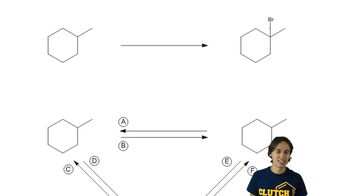
Functionalizing Alkanes

IUPAC Nomenclature

The International Union of Pure and Applied Chemistry (IUPAC) nomenclature provides a systematic way to name organic compounds. In the case of 4,4-diethyldecane, the name indicates that there are two ethyl groups attached to the fourth carbon of a decane chain, which consists of ten carbon atoms. Familiarity with IUPAC rules is crucial for accurately interpreting and constructing chemical structures.
Video consigliato:
03:43
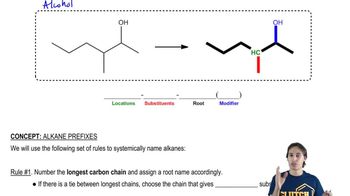
The different parts of an IUPAC name

Branching in Organic Molecules

Branching refers to the presence of substituent groups attached to the main carbon chain in organic molecules. In 4,4-diethyldecane, the two ethyl groups create branches off the main decane chain. Understanding how to represent these branches in structural formulas is vital for accurately depicting the molecule's structure.
Video consigliato:
02:17
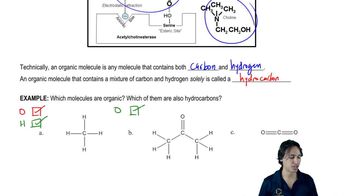
Identifying organic molecules