Ch. 3 - An Introduction to Organic Compounds: Nomenclature, Physical Properties, and Structure
Bruice - Organic Chemistry 8th Edition
Bruice8th EditionOrganic ChemistryISBN: 9780135213711Non è quello che usi tu?Cambia libro di testo
Capitolo 3, Problema 60

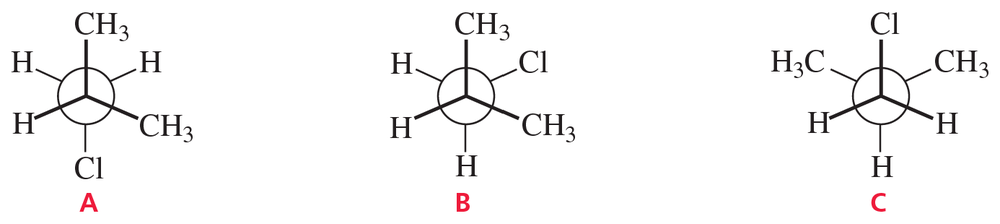
Which of the following conformers of isobutyl chloride is the most stable?
Three Newman projections of isobutyl chloride labeled A, B, and C, illustrating different conformers for stability comparison.

Guida verificata passo dopo passo
1
Step 1: Analyze the Newman projections provided for conformers A, B, and C. These projections represent the molecule viewed along the C-C bond axis, showing the spatial arrangement of substituents around the bond.
Step 2: Identify the bulky groups in the molecule. In isobutyl chloride, the CH3 groups are bulky, and their spatial arrangement will influence the stability of the conformers due to steric hindrance.
Step 3: Evaluate the positions of the substituents in each conformer. The most stable conformer will minimize steric hindrance by placing bulky groups as far apart as possible, typically in an anti-periplanar arrangement.
Step 4: Consider the interaction between the chlorine atom and the CH3 groups. Chlorine is less bulky than CH3, but its position relative to the CH3 groups can also affect stability due to dipole-dipole interactions.
Step 5: Determine which conformer has the least steric hindrance and the most favorable arrangement of substituents. This conformer will be the most stable.

Risposta video verificata per un problema simile:

Questa soluzione video è stata consigliata dai nostri tutor come utile per risolvere questo problema.
Durata del video:
1m

Concetti chiave

Ecco i concetti essenziali che devi comprendere per rispondere correttamente alla domanda.

Conformational Analysis

Conformational analysis involves studying the different spatial arrangements of a molecule that can be interconverted by rotation around single bonds. In the case of isobutyl chloride, the stability of its conformers is influenced by steric interactions and torsional strain, which can be evaluated through Newman projections.
Video consigliato:
03:29
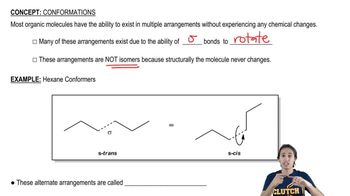
Understanding what a conformer is.

Steric Hindrance

Steric hindrance refers to the repulsion between atoms that occurs when they are brought close together, affecting the stability of molecular conformations. In the conformers of isobutyl chloride, bulky groups like the isobutyl group can create steric clashes, making certain conformations less stable than others.
Video consigliato:
02:53
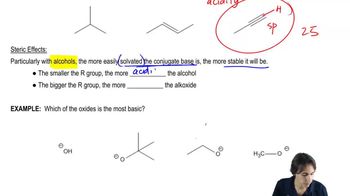
Understanding steric effects.

Torsional Strain

Torsional strain arises from the eclipsing interactions between atoms or groups in a molecule when they are aligned in a way that increases electron repulsion. In the context of isobutyl chloride, conformers that minimize torsional strain by adopting staggered arrangements are generally more stable than those with eclipsed conformations.
Video consigliato:
02:00
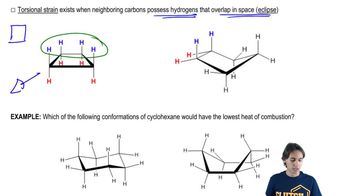
What is torsional strain?