Ch. 4 - Isomers: The Arrangement of Atoms in Space
Bruice - Organic Chemistry 8th Edition
Bruice8th EditionOrganic ChemistryISBN: 9780135213711Non è quello che usi tu?Cambia libro di testo
Capitolo 4, Problema 3(3,4)

For those compounds that can exist as cis and trans isomers, draw and label the isomers.
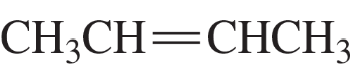
3. Structural formula of butene showing cis and trans isomers with labeled carbon and hydrogen atoms.
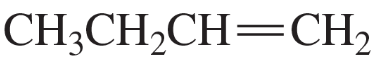
4. Structural formula of butene showing cis and trans isomers with labeled carbon atoms.

Guida verificata passo dopo passo
1
Identify the presence of a double bond in each compound. A double bond can give rise to cis-trans (geometric) isomerism if each carbon in the double bond has two different groups attached to it.
For compound 2 (CH3CH=CHCH3): Analyze the groups attached to the two carbons in the double bond. The first carbon has a CH3 group and a hydrogen atom, while the second carbon has a CH3 group and a hydrogen atom. Since each carbon in the double bond has two different groups, this compound can exhibit cis-trans isomerism.
Draw the cis isomer for CH3CH=CHCH3: In the cis isomer, the two CH3 groups are on the same side of the double bond, while the two hydrogen atoms are on the opposite side.
Draw the trans isomer for CH3CH=CHCH3: In the trans isomer, the two CH3 groups are on opposite sides of the double bond, and the two hydrogen atoms are also on opposite sides.
For compound 4 (CH3CH2CH=CH2): Analyze the groups attached to the two carbons in the double bond. The first carbon has a CH2CH3 group and a hydrogen atom, while the second carbon has two hydrogen atoms. Since one of the carbons in the double bond does not have two different groups, this compound cannot exhibit cis-trans isomerism.

Risposta video verificata per un problema simile:

Questa soluzione video è stata consigliata dai nostri tutor come utile per risolvere questo problema.
Durata del video:
7m

Concetti chiave

Ecco i concetti essenziali che devi comprendere per rispondere correttamente alla domanda.

Cis-Trans Isomerism

Cis-trans isomerism, also known as geometric isomerism, occurs in compounds with restricted rotation around a double bond or a ring structure. In cis isomers, substituents are on the same side of the double bond, while in trans isomers, they are on opposite sides. This difference in spatial arrangement can significantly affect the physical and chemical properties of the compounds.
Video consigliato:
00:44
Is the following cyclohexane cis or trans?

Alkenes and Double Bonds

Alkenes are hydrocarbons that contain at least one carbon-carbon double bond (C=C). The presence of this double bond is crucial for the existence of cis and trans isomers, as it restricts the rotation of the carbon atoms involved. Understanding the structure of alkenes is essential for identifying and drawing their isomers accurately.
Video consigliato:
06:00
Single bonds, double bonds, and triple bonds.

Drawing Structural Formulas

Drawing structural formulas involves representing the arrangement of atoms within a molecule, including bonds and functional groups. For cis and trans isomers, it is important to clearly depict the orientation of substituents around the double bond. Accurate structural representation helps in visualizing the differences between isomers and understanding their reactivity and properties.
Video consigliato:
05:21
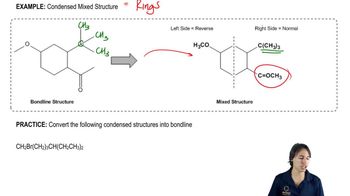
How to draw condensed mixed structures.