Ch. 4 - Isomers: The Arrangement of Atoms in Space
Bruice - Organic Chemistry 8th Edition
Bruice8th EditionOrganic ChemistryISBN: 9780135213711Non è quello che usi tu?Cambia libro di testo
Capitolo 4, Problema 90(5-8)

Identify
5. achiral compounds
6. meso compounds
7. enantiomers
8. diastereomers

Guida verificata passo dopo passo
1
Step 1: To identify achiral compounds, look for molecules that lack a chiral center or have a plane of symmetry. For example, ethylcyclopentane (structure i) is achiral because it has no chiral centers.
Step 2: To identify meso compounds, look for molecules with multiple chiral centers that have an internal plane of symmetry, making them achiral despite having chiral centers. For example, (1R,3S)-1,3-dimethylcyclopentane (structure iv) is a meso compound due to its symmetry.
Step 3: To identify enantiomers, look for pairs of molecules that are non-superimposable mirror images of each other. For example, (1R,2S)-1,2-dimethylcyclopentane (structure iii) and its mirror image (not shown here) would be enantiomers.
Step 4: To identify diastereomers, look for stereoisomers that are not mirror images of each other. For example, trans-1,2-dimethylcyclopentane (structure v) and cis-1,2-dimethylcyclopentane (structure vi) are diastereomers.
Step 5: Analyze each structure systematically to confirm the presence or absence of chirality, symmetry, and stereoisomeric relationships. Use the definitions of achiral, meso, enantiomers, and diastereomers to classify each compound accurately.

Risposta video verificata per un problema simile:

Questa soluzione video è stata consigliata dai nostri tutor come utile per risolvere questo problema.
Durata del video:
7m

Concetti chiave

Ecco i concetti essenziali che devi comprendere per rispondere correttamente alla domanda.

Chirality

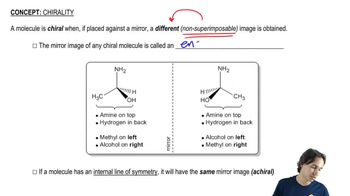
Chirality refers to the geometric property of a molecule that makes it non-superimposable on its mirror image. A chiral molecule typically has at least one carbon atom bonded to four different substituents, resulting in two distinct enantiomers. Understanding chirality is crucial for distinguishing between compounds that may have identical molecular formulas but different spatial arrangements, leading to different chemical properties.
Video consigliato:
05:10
What is chirality?

Stereoisomers

Stereoisomers are compounds that have the same molecular formula and connectivity of atoms but differ in the spatial arrangement of their atoms. This category includes enantiomers, which are non-superimposable mirror images, and diastereomers, which are not mirror images of each other. Recognizing stereoisomers is essential for understanding the behavior of molecules in biological systems and their reactivity in chemical reactions.
Video consigliato:
01:58
Determining when molecules are stereoisomers.

Meso Compounds

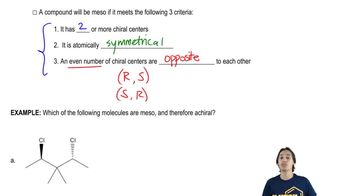
Meso compounds are a specific type of stereoisomer that contain multiple chiral centers but are achiral due to an internal plane of symmetry. This means that despite having chiral centers, the overall molecule does not exhibit optical activity. Identifying meso compounds is important in stereochemistry as they can often be mistaken for chiral compounds, affecting their classification and reactivity.
Video consigliato:
04:10
The 3 rules of meso compounds.