Ch. 4 - Isomers: The Arrangement of Atoms in Space
Bruice - Organic Chemistry 8th Edition
Bruice8th EditionOrganic ChemistryISBN: 9780135213711Non è quello che usi tu?Cambia libro di testo
Capitolo 4, Problema 51g,h

Draw all the stereoisomers for each of the following:
g. 1,3-dichlorocyclohexane
h. 1,4-dichlorocyclohexane

Guida verificata passo dopo passo
1
Step 1: Understand the concept of stereoisomers. Stereoisomers are compounds with the same molecular formula and connectivity of atoms but differ in the spatial arrangement of atoms. For cyclohexane derivatives, consider both cis (same side) and trans (opposite side) configurations.
Step 2: Analyze the structure of 1,3-dichlorocyclohexane. The chlorine atoms are attached to the 1st and 3rd carbons of the cyclohexane ring. Consider the chair conformation of cyclohexane, where substituents can occupy axial (vertical) or equatorial (horizontal) positions.
Step 3: Draw the stereoisomers for 1,3-dichlorocyclohexane. For cis-1,3-dichlorocyclohexane, both chlorine atoms will be on the same side of the ring (either both axial or both equatorial). For trans-1,3-dichlorocyclohexane, one chlorine will be axial and the other equatorial, on opposite sides of the ring.
Step 4: Analyze the structure of 1,4-dichlorocyclohexane. The chlorine atoms are attached to the 1st and 4th carbons of the cyclohexane ring. Again, consider the chair conformation and the spatial arrangement of substituents.
Step 5: Draw the stereoisomers for 1,4-dichlorocyclohexane. For cis-1,4-dichlorocyclohexane, both chlorine atoms will be on the same side of the ring (either both axial or both equatorial). For trans-1,4-dichlorocyclohexane, one chlorine will be axial and the other equatorial, on opposite sides of the ring.

Risposta video verificata per un problema simile:

Questa soluzione video è stata consigliata dai nostri tutor come utile per risolvere questo problema.
Durata del video:
4m

Concetti chiave

Ecco i concetti essenziali che devi comprendere per rispondere correttamente alla domanda.

Stereoisomerism

Stereoisomerism refers to the phenomenon where compounds have the same molecular formula and connectivity of atoms but differ in the spatial arrangement of their atoms. This can lead to different physical and chemical properties. In organic chemistry, stereoisomers can be classified into two main types: geometric isomers (cis/trans) and optical isomers (enantiomers). Understanding stereoisomerism is crucial for drawing and identifying the different forms of compounds like 1,3-dichlorocyclohexane and 1,4-dichlorocyclohexane.
Video consigliato:
01:58
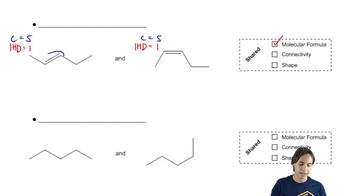
Determining when molecules are stereoisomers.

Cyclohexane Conformation

Cyclohexane can adopt various conformations, primarily the chair and boat forms, which significantly influence the stability and reactivity of substituents on the ring. The chair conformation is the most stable due to minimized steric strain, while substituents can occupy axial or equatorial positions. Recognizing these conformations is essential for accurately determining the stereochemistry of substituted cyclohexanes, such as the dichlorocyclohexanes in the question.
Video consigliato:
03:29
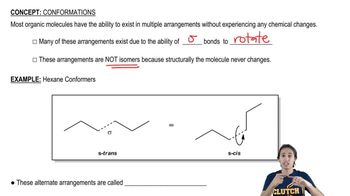
Understanding what a conformer is.

Chirality and Optical Activity

Chirality occurs when a molecule cannot be superimposed on its mirror image, often due to the presence of a chiral center, typically a carbon atom bonded to four different substituents. Molecules that are chiral exhibit optical activity, meaning they can rotate plane-polarized light. In the context of 1,3-dichlorocyclohexane and 1,4-dichlorocyclohexane, identifying chiral centers is vital for determining the number of stereoisomers and their configurations.
Video consigliato:
08:17
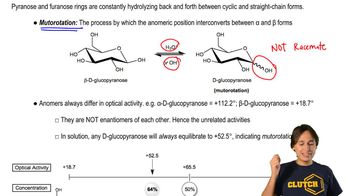
Mutarotation and Optical Activity