Ch. 4 - Isomers: The Arrangement of Atoms in Space
Bruice - Organic Chemistry 8th Edition
Bruice8th EditionOrganic ChemistryISBN: 9780135213711Non è quello che usi tu?Cambia libro di testo
Capitolo 4, Problema 99c

What is the configuration of each of the asymmetric centers in the following compounds?
c.

Guida verificata passo dopo passo
1
Step 1: Identify the asymmetric center in the molecule. An asymmetric center is a carbon atom bonded to four different groups. In this case, the carbon atom in the cyclobutane ring is bonded to an -OH group, a -Br group, a hydrogen atom, and the rest of the cyclobutane ring.
Step 2: Assign priorities to the substituents attached to the asymmetric center based on the Cahn-Ingold-Prelog (CIP) priority rules. The priority is determined by the atomic number of the atoms directly attached to the asymmetric center. Bromine (Br) has the highest priority (atomic number 35), followed by oxygen (O) in the -OH group (atomic number 8), then the carbon in the cyclobutane ring, and finally hydrogen (H) with the lowest priority (atomic number 1).
Step 3: Orient the molecule so that the substituent with the lowest priority (hydrogen) is pointing away from you (on the dashed wedge). This orientation is crucial for determining the configuration.
Step 4: Determine the order of the remaining substituents (1 → 2 → 3) in a clockwise or counterclockwise direction. If the sequence is clockwise, the configuration is R. If the sequence is counterclockwise, the configuration is S.
Step 5: Based on the analysis, assign the configuration (R or S) to the asymmetric center. Ensure that the orientation and priority rules are applied correctly to arrive at the configuration.

Risposta video verificata per un problema simile:

Questa soluzione video è stata consigliata dai nostri tutor come utile per risolvere questo problema.
Durata del video:
2m

Concetti chiave

Ecco i concetti essenziali che devi comprendere per rispondere correttamente alla domanda.

Asymmetric Centers

Asymmetric centers, or chiral centers, are carbon atoms bonded to four different substituents, leading to non-superimposable mirror images known as enantiomers. Identifying these centers is crucial for determining the stereochemistry of a compound, as the spatial arrangement of substituents affects the compound's properties and reactivity.
Video consigliato:
03:38
How to add to asymmetrical double bonds.

Cahn-Ingold-Prelog Priority Rules

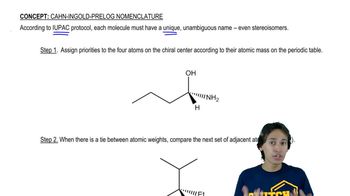
The Cahn-Ingold-Prelog (CIP) priority rules are a set of guidelines used to assign priorities to substituents attached to chiral centers. By comparing the atomic numbers of the atoms directly bonded to the chiral carbon, one can determine the order of priority, which is essential for assigning the R or S configuration to the asymmetric centers.
Video consigliato:
01:48
Why stereoisomers need their own naming system.

Stereochemistry

Stereochemistry is the study of the spatial arrangement of atoms in molecules and how this arrangement affects their chemical behavior. Understanding stereochemistry is vital for predicting the interactions and reactions of chiral compounds, as different configurations can lead to vastly different biological activities and properties.
Video consigliato:
Percorso guidato
1:38
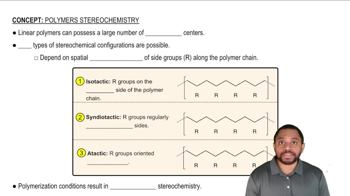
Polymer Stereochemistry Concept 1