Ch. 5 - Alkenes: Structure, Nomenclature, and an Introduction to Reactivity • Thermodynamics and Kinetics
Bruice - Organic Chemistry 8th Edition
Bruice8th EditionOrganic ChemistryISBN: 9780135213711Non è quello che usi tu?Cambia libro di testo
Capitolo 5, Problema 53d

For each of the following compounds, draw the possible geometric isomers and name each isomer:
d. 3-methyl-2,4-hexadiene

Guida verificata passo dopo passo
1
Step 1: Understand the structure of 3-methyl-2,4-hexadiene. The compound is a diene, meaning it contains two double bonds. The parent chain is hexadiene (a six-carbon chain with two double bonds), and there is a methyl group attached to the third carbon.
Step 2: Identify the positions of the double bonds. The double bonds are located at carbons 2 and 4. Each double bond can exhibit geometric (cis/trans or E/Z) isomerism because the carbons involved in the double bonds have different substituents.
Step 3: Analyze the substituents around each double bond. For the double bond at carbon 2, the substituents are: (a) a hydrogen atom and (b) the rest of the chain (C3-C6). For the double bond at carbon 4, the substituents are: (a) a hydrogen atom and (b) the rest of the chain (C5-C6).
Step 4: Draw all possible geometric isomers. For each double bond, determine whether the substituents are on the same side (cis or Z) or opposite sides (trans or E). Combine the configurations of both double bonds to generate all possible isomers. For example, you could have (Z,Z), (Z,E), (E,Z), and (E,E) configurations.
Step 5: Name each isomer using the E/Z nomenclature. Assign priorities to the substituents on each double bond using the Cahn-Ingold-Prelog priority rules. Based on the relative positions of the higher-priority groups, assign E (opposite sides) or Z (same side) to each double bond and name the compound accordingly (e.g., (2E,4Z)-3-methyl-2,4-hexadiene).

Risposta video verificata per un problema simile:

Questa soluzione video è stata consigliata dai nostri tutor come utile per risolvere questo problema.
Durata del video:
6m

Concetti chiave

Ecco i concetti essenziali che devi comprendere per rispondere correttamente alla domanda.

Geometric Isomerism

Geometric isomerism occurs due to the restricted rotation around double bonds or ring structures, leading to different spatial arrangements of atoms. In alkenes, this is often classified into cis and trans isomers, where 'cis' indicates that substituents are on the same side of the double bond, while 'trans' indicates they are on opposite sides. Understanding this concept is crucial for identifying and drawing the correct isomers of compounds like 3-methyl-2,4-hexadiene.
Video consigliato:
06:47
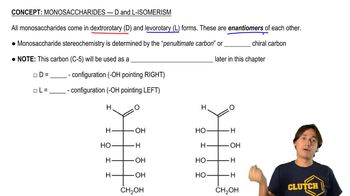
Monosaccharides - D and L Isomerism

Alkene Nomenclature

Alkene nomenclature follows specific rules set by the IUPAC system, which includes identifying the longest carbon chain containing the double bond and numbering it to give the lowest possible numbers to the double bond. For 3-methyl-2,4-hexadiene, the name indicates the presence of a double bond between the second and third carbons and another between the fourth and fifth carbons, along with a methyl group on the third carbon. This understanding is essential for accurately naming the geometric isomers.
Video consigliato:
Percorso guidato
4:02
Nomenclature of Heterocycles Concept 2

Stereochemistry

Stereochemistry is the study of the spatial arrangement of atoms in molecules and how this affects their chemical behavior. In the context of geometric isomers, it helps in understanding how different arrangements can lead to distinct physical and chemical properties. For 3-methyl-2,4-hexadiene, recognizing the stereochemical implications of the double bonds is vital for drawing and naming the correct isomers, as the arrangement of substituents can significantly influence the compound's characteristics.
Video consigliato:
Percorso guidato
1:38
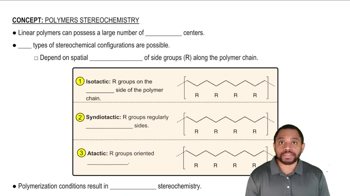
Polymer Stereochemistry Concept 1