Ch. 6 - The Reactions of Alkenes • The Stereochemistry of Addition Reactions
Bruice - Organic Chemistry 8th Edition
Bruice8th EditionOrganic ChemistryISBN: 9780135213711Non è quello che usi tu?Cambia libro di testo
Capitolo 6, Problema 21a

How does the first step in the reaction of propene with Br2 differ from the first step in the reaction of propene with HBr?

Guida verificata passo dopo passo
1
The first step in the reaction of propene with Br₂ involves the formation of a bromonium ion intermediate. This occurs through an electrophilic addition mechanism where the π-electrons of the double bond in propene attack one of the bromine atoms in Br₂, leading to the formation of a cyclic bromonium ion and a bromide ion (Br⁻).
In contrast, the first step in the reaction of propene with HBr involves the formation of a carbocation intermediate. The π-electrons of the double bond in propene attack the hydrogen atom in HBr, resulting in the addition of a proton (H⁺) to one of the carbon atoms in the double bond, leaving behind a carbocation on the other carbon atom.
The key difference lies in the intermediates formed: the reaction with Br₂ forms a bromonium ion, which is a three-membered cyclic structure, while the reaction with HBr forms a carbocation, which is a planar, positively charged species.
The driving force for the reaction with Br₂ is the polarization of the Br-Br bond due to the electron-rich double bond in propene, whereas the reaction with HBr is driven by the electrophilic nature of the proton (H⁺) in HBr.
Understanding these differences is crucial because the nature of the intermediate (bromonium ion vs. carbocation) determines the subsequent steps and the stereochemistry of the final product in each reaction.

Risposta video verificata per un problema simile:

Questa soluzione video è stata consigliata dai nostri tutor come utile per risolvere questo problema.
Durata del video:
4m

Concetti chiave

Ecco i concetti essenziali che devi comprendere per rispondere correttamente alla domanda.

Electrophilic Addition Reactions

Electrophilic addition reactions are a fundamental type of reaction in organic chemistry where an electrophile reacts with a nucleophile, resulting in the formation of a more saturated product. In the case of alkenes like propene, the double bond acts as a nucleophile, attacking the electrophile, which can be a halogen or a hydrogen halide. Understanding this concept is crucial for analyzing how different electrophiles interact with alkenes.
Video consigliato:
05:39
Features of Addition Mechanisms.

Mechanism of Bromination

The bromination of alkenes involves the formation of a cyclic bromonium ion intermediate, which is a key step in the reaction mechanism. This intermediate is formed when Br2 approaches the double bond, leading to a three-membered ring structure. The subsequent attack by a bromide ion results in the formation of a vicinal dibromide. This mechanism differs from that of hydrogen halides, where no such cyclic intermediate is formed.
Video consigliato:
00:54
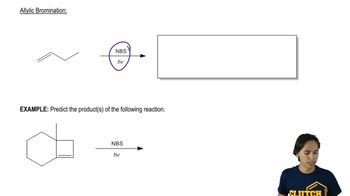
Mechanism of Allylic Bromination.

Hydrogen Halide Addition Mechanism

The addition of hydrogen halides, such as HBr, to alkenes follows a different mechanism compared to halogen addition. In this case, the hydrogen atom from HBr acts as the electrophile, leading to the formation of a carbocation intermediate. The stability of this carbocation influences the regioselectivity of the reaction, which is not a factor in the bromination mechanism. Understanding these differences is essential for predicting the products of these reactions.
Video consigliato:
05:39
Features of Addition Mechanisms.