Ch. 6 - The Reactions of Alkenes • The Stereochemistry of Addition Reactions
Bruice - Organic Chemistry 8th Edition
Bruice8th EditionOrganic ChemistryISBN: 9780135213711Non è quello che usi tu?Cambia libro di testo
Capitolo 6, Problema 13

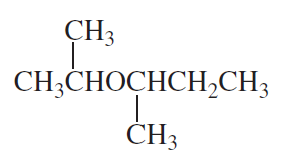
How could the following compound be prepared using an alkene as one of the starting materials?
Structural formula of an ether compound with alkyl groups and an ether linkage, illustrating alkoxylation preparation.

Guida verificata passo dopo passo
1
Analyze the target compound: The given compound is a tertiary alcohol with the structure 2,3-dimethyl-2-butanol. This indicates that the preparation involves the addition of a hydroxyl group (-OH) to a carbon atom in a highly substituted environment.
Select an appropriate alkene: To prepare this compound, the starting alkene should be 2,3-dimethyl-2-butene, as it has the same carbon skeleton as the target compound and can undergo hydration to form the alcohol.
Choose the reaction conditions: The hydration of the alkene can be achieved using acid-catalyzed hydration (e.g., H₂SO₄ and water) or oxymercuration-demercuration (using Hg(OAc)₂ and NaBH₄). These methods ensure Markovnikov addition, where the hydroxyl group attaches to the more substituted carbon.
Explain the mechanism: In acid-catalyzed hydration, the alkene undergoes protonation to form a carbocation intermediate at the more substituted carbon. Water then attacks the carbocation, followed by deprotonation to yield the alcohol. In oxymercuration-demercuration, the alkene reacts with Hg(OAc)₂ to form a mercurinium ion intermediate, which is then attacked by water. Reduction with NaBH₄ replaces the mercury group with a hydrogen atom, forming the alcohol.
Verify the product: Ensure that the reaction conditions lead to the formation of 2,3-dimethyl-2-butanol as the major product, with the hydroxyl group attached to the tertiary carbon. This matches the structure of the target compound.

Risposta video verificata per un problema simile:

Questa soluzione video è stata consigliata dai nostri tutor come utile per risolvere questo problema.
Durata del video:
4m

Concetti chiave

Ecco i concetti essenziali che devi comprendere per rispondere correttamente alla domanda.

Alkene Reactivity

Alkenes are unsaturated hydrocarbons characterized by at least one carbon-carbon double bond. Their reactivity is primarily due to this double bond, which can undergo various reactions such as electrophilic addition, polymerization, and alkoxylation. Understanding how alkenes react is crucial for synthesizing compounds, as they can serve as versatile starting materials in organic reactions.
Video consigliato:
Percorso guidato
2:09
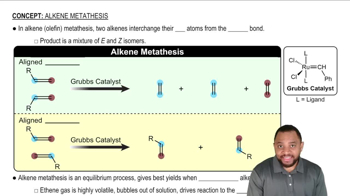
Alkene Metathesis Concept 1

Alkoxylation

Alkoxylation is a chemical reaction where an alkene reacts with an alcohol in the presence of an acid catalyst to form an ether. This process involves the formation of a carbocation intermediate, which can then react with the alcohol to yield the ether product. Recognizing the mechanism of alkoxylation is essential for preparing ethers from alkenes, as it highlights the importance of regioselectivity and stereochemistry in the reaction.
Video consigliato:
04:25
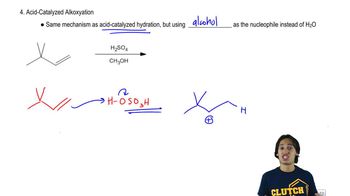
The Mechanism of Alkoxylation.

Ether Synthesis

Ethers are organic compounds characterized by an oxygen atom bonded to two alkyl or aryl groups. They can be synthesized through various methods, including the alkoxylation of alkenes, as well as through the dehydration of alcohols. Understanding the structural features and reactivity of ethers is important for predicting their behavior in chemical reactions and their applications in organic synthesis.
Video consigliato:
03:50
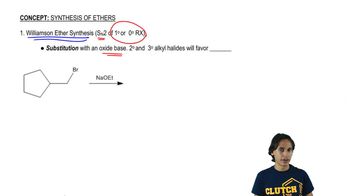
The Mechanism of Williamson Ether Synthesis.