Ch. 6 - The Reactions of Alkenes • The Stereochemistry of Addition Reactions
Bruice - Organic Chemistry 8th Edition
Bruice8th EditionOrganic ChemistryISBN: 9780135213711Non è quello che usi tu?Cambia libro di testo
Capitolo 6, Problema 22

Why are Na+ and K+ unable to form covalent bonds?

Guida verificata passo dopo passo
1
Understand the nature of Na+ and K+: Sodium (Na) and Potassium (K) are alkali metals located in Group 1 of the periodic table. When they lose one electron, they form Na+ and K+ cations, respectively, achieving a stable noble gas electron configuration.
Recognize the electronic configuration of Na+ and K+: Na+ has the electron configuration of [Ne], and K+ has the electron configuration of [Ar]. Both ions have a full outer shell, making them highly stable and unlikely to share electrons.
Recall the definition of covalent bonds: Covalent bonds are formed when two atoms share electrons to achieve a stable electron configuration. This typically occurs between nonmetals with similar electronegativities.
Analyze the properties of Na+ and K+: Since Na+ and K+ are positively charged ions, they lack valence electrons to share with other atoms. This absence of valence electrons makes it impossible for them to participate in covalent bonding.
Conclude why Na+ and K+ cannot form covalent bonds: The inability of Na+ and K+ to share electrons, combined with their stable noble gas configurations, means they are restricted to forming ionic bonds rather than covalent bonds.

Risposta video verificata per un problema simile:

Questa soluzione video è stata consigliata dai nostri tutor come utile per risolvere questo problema.
Durata del video:
5m

Concetti chiave

Ecco i concetti essenziali che devi comprendere per rispondere correttamente alla domanda.

Ionic vs. Covalent Bonds

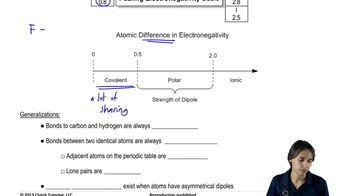
Ionic bonds form between atoms with significantly different electronegativities, where one atom donates an electron to another, resulting in charged ions. In contrast, covalent bonds involve the sharing of electrons between atoms with similar electronegativities. Understanding this distinction is crucial for explaining why certain elements, like Na+ and K+, do not form covalent bonds.
Video consigliato:
11:33
Differences between ionic, polar and covalent bonds

Electronegativity

Electronegativity is a measure of an atom's ability to attract and hold onto electrons. Sodium (Na) and potassium (K) have low electronegativities, which means they tend to lose electrons rather than share them. This property makes them more likely to form ionic bonds with electronegative elements rather than covalent bonds with other metals or nonmetals.
Video consigliato:
1:47
Electronegativity

Ion Formation

Na+ and K+ are cations formed when sodium and potassium atoms lose one electron, respectively. This loss results in a stable electron configuration similar to noble gases. Since these ions are already stable in their ionic form, they do not seek to share electrons through covalent bonding, which is typically a characteristic of neutral atoms.
Video consigliato:
Percorso guidato
3:39
Metal Ion Catalysis Concept 1