



Ch. 7 - The Reactions of Alkynes • An Introduction to Multistep Synthesis
Bruice - Organic Chemistry 8th Edition
Bruice8th EditionOrganic ChemistryISBN: 9780135213711Non è quello che usi tu?Cambia libro di testo
Capitolo 7, Problema 52c

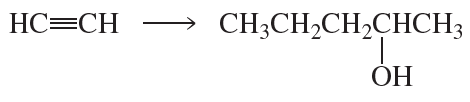
Show how each of the following compounds can be prepared using the given starting material, any needed inorganic reagents, and any ­organic compound that has no more than four carbons:
c. Reaction scheme showing the conversion of an alkyne to a primary alcohol with a four-carbon chain.

Guida verificata passo dopo passo
1
Analyze the target compound and identify the functional groups present. Determine the transformations required to convert the given starting material into the target compound.
Break down the synthesis into smaller steps. Identify the reagents and conditions needed for each transformation, ensuring that any organic intermediates used have no more than four carbons.
For each step, consider the reaction mechanism and the regioselectivity or stereoselectivity (if applicable). Ensure that the chosen reagents and conditions are compatible with the functional groups present in the molecule.
Write out the sequence of reactions, starting from the given starting material, and show how each intermediate is formed. Include the reagents and conditions for each step.
Verify that the final product matches the target compound and that all intermediates and reagents used comply with the constraints of the problem (e.g., organic compounds with no more than four carbons).

Risposta video verificata per un problema simile:

Questa soluzione video è stata consigliata dai nostri tutor come utile per risolvere questo problema.
Durata del video:
7m

Concetti chiave

Ecco i concetti essenziali che devi comprendere per rispondere correttamente alla domanda.

Functional Groups

Functional groups are specific groups of atoms within molecules that are responsible for the characteristic chemical reactions of those molecules. Understanding functional groups is essential in organic chemistry as they dictate the reactivity and properties of compounds. For example, alcohols contain hydroxyl (-OH) groups, which influence their solubility and reactivity.
Video consigliato:
02:36
Identifying Functional Groups

Reaction Mechanisms

Reaction mechanisms describe the step-by-step process by which reactants are transformed into products. This includes the breaking and forming of bonds, the movement of electrons, and the intermediates formed during the reaction. A clear understanding of mechanisms is crucial for predicting the outcomes of reactions and for designing synthetic pathways.
Video consigliato:
02:16
Heck Reaction Mechanism

Synthesis Strategies

Synthesis strategies involve planning the steps needed to construct a target molecule from available starting materials. This includes selecting appropriate reagents and conditions to achieve desired transformations. Knowledge of various synthetic methods, such as functional group interconversions and coupling reactions, is vital for successfully preparing organic compounds.
Video consigliato:
Percorso guidato
1:16
Synthesis of Amino Acids: Strecker Synthesis Example 1