Ch. 7 - The Reactions of Alkynes • An Introduction to Multistep Synthesis
Bruice - Organic Chemistry 8th Edition
Bruice8th EditionOrganic ChemistryISBN: 9780135213711Non è quello che usi tu?Cambia libro di testo
Capitolo 7, Problema 50a

Show how the following compounds can be synthesized starting with ethyne:
a. cis-2-octene

Guida verificata passo dopo passo
1
Step 1: Start with ethyne (C₂H₂), which is a terminal alkyne. The first step is to elongate the carbon chain. Perform a reaction with sodium amide (NaNH₂) to deprotonate the terminal hydrogen of ethyne, forming the acetylide ion (C≡C⁻).
Step 2: React the acetylide ion with 1-bromobutane (CH₃CH₂CH₂CH₂Br) in an SN2 reaction. This will result in the formation of 1-hexyne (CH₃CH₂CH₂CH₂C≡CH), which is a longer alkyne chain.
Step 3: To convert the terminal alkyne into an internal alkyne, perform another alkylation. Deprotonate the terminal hydrogen of 1-hexyne using sodium amide (NaNH₂) to form the corresponding acetylide ion. Then react this ion with ethyl bromide (CH₃CH₂Br) to form 3-octyne (CH₃CH₂CH₂CH₂C≡CCH₂CH₃).
Step 4: Reduce the triple bond of 3-octyne to a cis double bond. Use Lindlar's catalyst (Pd/CaCO₃ poisoned with quinoline) and hydrogen gas (H₂) to selectively hydrogenate the alkyne to cis-2-octene (CH₃CH₂CH₂CH₂CH=CHCH₂CH₃).
Step 5: Verify the stereochemistry of the product. Lindlar's catalyst ensures the formation of the cis isomer of the alkene, so the final product is cis-2-octene.

Risposta video verificata per un problema simile:

Questa soluzione video è stata consigliata dai nostri tutor come utile per risolvere questo problema.
Durata del video:
3m

Concetti chiave

Ecco i concetti essenziali che devi comprendere per rispondere correttamente alla domanda.

Ethyne as a Building Block

Ethyne, also known as acetylene, is a simple alkyne that serves as a versatile building block in organic synthesis. Its triple bond allows for various reactions, including addition reactions with electrophiles, which can lead to the formation of more complex molecules. Understanding how to manipulate ethyne's reactivity is crucial for synthesizing larger compounds like cis-2-octene.
Video consigliato:
16:59
Building a molecular sentence

Hydroboration-Oxidation

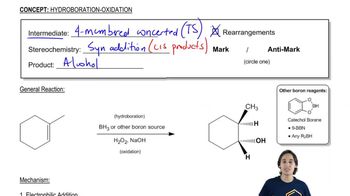
The hydroboration-oxidation reaction is a two-step process used to convert alkenes into alcohols. In the first step, borane adds to the alkene, resulting in a trialkylborane intermediate. The subsequent oxidation with hydrogen peroxide and sodium hydroxide converts the boron to a hydroxyl group, yielding an alcohol. This method is particularly useful for synthesizing specific stereoisomers, such as cis-2-octene.
Video consigliato:
06:38
General properties of hydroboration-oxidation.

Stereochemistry of Alkenes

Stereochemistry refers to the spatial arrangement of atoms in molecules and is crucial in determining the properties and reactivity of alkenes. For cis-2-octene, the 'cis' designation indicates that the substituents on the double bond are on the same side, which affects its physical properties and reactivity. Understanding stereochemistry is essential for predicting the outcomes of reactions and for synthesizing specific isomers.
Video consigliato:
Percorso guidato
1:38
Polymer Stereochemistry Concept 1