Ch. 8 - Delocalized Electrons: Their Effect on Stability, pKa, and the Products of a Reaction • Aromaticity and Electronic Effects: An Introduction to the Reactions of Benzene
Bruice - Organic Chemistry 8th Edition
Bruice8th EditionOrganic ChemistryISBN: 9780135213711Non è quello che usi tu?Cambia libro di testo
Capitolo 8, Problema 86a

Answer the following questions for the molecular orbitals (MOs) of 1,3,5,7-octatetraene:
a. How many MOs does the compound have?

Guida verificata passo dopo passo
1
Count the number of conjugated π-electrons in the molecule. In 1,3,5,7-octatetraene, there are four double bonds, each contributing two π-electrons, for a total of 8 π-electrons.
Determine the number of atomic p orbitals involved in the conjugated π-system. Each carbon atom in the conjugated system contributes one p orbital. Since there are 8 carbons in the conjugated system, there are 8 p orbitals.
Recall that the number of molecular orbitals (MOs) formed in a conjugated π-system is equal to the number of atomic p orbitals involved. Therefore, 8 MOs will be formed.
Understand that these 8 MOs will include bonding, non-bonding, and anti-bonding orbitals, arranged in increasing energy levels based on the overlap of the p orbitals.
Conclude that the compound 1,3,5,7-octatetraene has 8 molecular orbitals (MOs) in its conjugated π-system.

Risposta video verificata per un problema simile:

Questa soluzione video è stata consigliata dai nostri tutor come utile per risolvere questo problema.
Durata del video:
2m

Concetti chiave

Ecco i concetti essenziali che devi comprendere per rispondere correttamente alla domanda.

Molecular Orbitals (MOs)

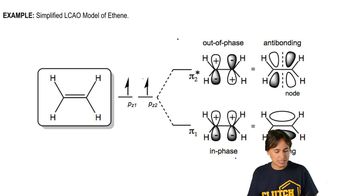
Molecular orbitals are formed by the linear combination of atomic orbitals (LCAO) when atoms bond together. In a molecule, these orbitals can be occupied by electrons and are classified as bonding, antibonding, or non-bonding. The number of MOs corresponds to the number of atomic orbitals that combine, which is crucial for understanding the electronic structure of the molecule.
Video consigliato:
08:41
Review of Molecular Orbitals

Conjugation

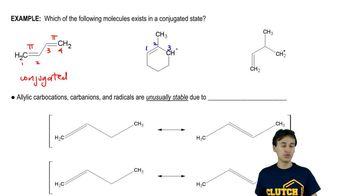
Conjugation refers to the overlap of p-orbitals across adjacent double bonds, allowing for delocalization of electrons. In 1,3,5,7-octatetraene, the alternating double bonds create a system of conjugated MOs, which lowers the energy of the system and increases stability. This concept is essential for determining the number and type of MOs in conjugated systems.
Video consigliato:
03:27
Conjugated states

Counting Molecular Orbitals

The total number of molecular orbitals in a molecule is equal to the number of atomic orbitals that combine to form them. For 1,3,5,7-octatetraene, which has eight carbon atoms, each contributing one p-orbital, the total number of MOs is equal to the number of contributing atomic orbitals. This principle is fundamental for calculating the MOs in any given molecule.
Video consigliato:
08:41
Review of Molecular Orbitals