Ch. 8 - Delocalized Electrons: Their Effect on Stability, pKa, and the Products of a Reaction • Aromaticity and Electronic Effects: An Introduction to the Reactions of Benzene
Bruice - Organic Chemistry 8th Edition
Bruice8th EditionOrganic ChemistryISBN: 9780135213711Non è quello che usi tu?Cambia libro di testo
Capitolo 8, Problema 65

Draw all the products of the following reaction:

Guida verificata passo dopo passo
1
Step 1: Analyze the reactants. The molecule shown is a cyclooctatrienyl cation (C8H7+), which is aromatic due to its Huckel rule compliance (4n+2 π electrons, where n=1). It is bonded to a chlorine atom. The other reactant is hydroxide ion (HO⁻), a strong nucleophile and base.
Step 2: Consider the reaction mechanism. The hydroxide ion can act as a nucleophile and attack the positively charged carbon atom bonded to chlorine, leading to a substitution reaction. This is likely an SN2 mechanism due to the steric accessibility of the carbon.
Step 3: Predict the product of the substitution. The chlorine atom will be replaced by the hydroxide group, resulting in the formation of a cyclooctatrienyl alcohol (C8H7OH).
Step 4: Consider any possible side reactions. Since hydroxide is a strong base, it could also abstract a proton from the cyclooctatrienyl cation, leading to the formation of a neutral cyclooctatriene molecule (C8H8).
Step 5: Draw all possible products. The main product is cyclooctatrienyl alcohol (C8H7OH), and a potential side product is cyclooctatriene (C8H8). Ensure to represent the aromaticity in the structures of the products.

Risposta video verificata per un problema simile:

Questa soluzione video è stata consigliata dai nostri tutor come utile per risolvere questo problema.
Durata del video:
7m

Concetti chiave

Ecco i concetti essenziali che devi comprendere per rispondere correttamente alla domanda.

Reaction Mechanisms

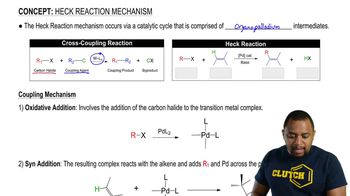
Understanding reaction mechanisms is crucial in organic chemistry as they describe the step-by-step process by which reactants transform into products. This includes identifying intermediates, transition states, and the movement of electrons. A clear grasp of mechanisms helps predict the products formed in a reaction.
Video consigliato:
02:16
Heck Reaction Mechanism

Functional Groups

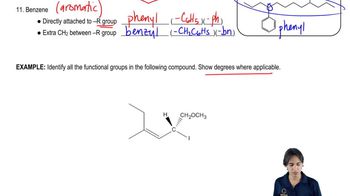
Functional groups are specific groups of atoms within molecules that are responsible for the characteristic chemical reactions of those molecules. Recognizing functional groups in the reactants allows chemists to anticipate how they will interact and what products will be formed. This knowledge is essential for drawing accurate reaction products.
Video consigliato:
02:36
Identifying Functional Groups

Stereochemistry

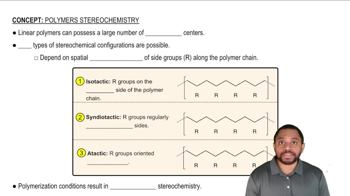
Stereochemistry involves the study of the spatial arrangement of atoms in molecules and how this affects their chemical behavior. In reactions, the stereochemistry of reactants can lead to different stereoisomers as products. Understanding stereochemistry is vital for accurately representing all possible products, especially in reactions involving chiral centers.
Video consigliato:
Percorso guidato
1:38
Polymer Stereochemistry Concept 1