Ch. 8 - Delocalized Electrons: Their Effect on Stability, pKa, and the Products of a Reaction • Aromaticity and Electronic Effects: An Introduction to the Reactions of Benzene
Bruice - Organic Chemistry 8th Edition
Bruice8th EditionOrganic ChemistryISBN: 9780135213711Non è quello che usi tu?Cambia libro di testo
Capitolo 8, Problema 6c

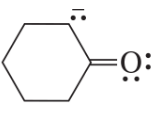
Draw resonance contributors for each of the following species and rank them in order of decreasing contribution to the resonance hybrid. Then draw the resonance hybrid.
c. Hexagonal ring structure with an oxygen atom, showing resonance contributors and electron pairs for chemical analysis.

Guida verificata passo dopo passo
1
Identify the species in question and determine if it has resonance structures. Resonance occurs when there are delocalized electrons, such as lone pairs, π-bonds, or charges, that can be redistributed across the molecule.
Draw all possible resonance contributors for the species. To do this, move electrons (using curved arrows) while ensuring that the octet rule is satisfied for second-row elements and that formal charges are minimized. Use MathML to represent the structures if needed.
Evaluate the stability of each resonance contributor. Contributors with a full octet on all atoms, minimal formal charges, and negative charges on more electronegative atoms are more stable and contribute more to the resonance hybrid.
Rank the resonance contributors in order of decreasing contribution to the resonance hybrid based on their stability. The most stable contributor will have the highest contribution, while less stable contributors will contribute less.
Draw the resonance hybrid by combining the resonance contributors. Use dashed lines to represent delocalized π-bonds and partial charges to indicate the distribution of charge across the molecule.

Risposta video verificata per un problema simile:

Questa soluzione video è stata consigliata dai nostri tutor come utile per risolvere questo problema.
Durata del video:
6m

Concetti chiave

Ecco i concetti essenziali che devi comprendere per rispondere correttamente alla domanda.

Resonance Structures

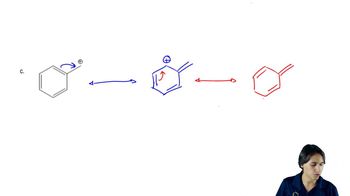
Resonance structures are different Lewis structures for the same molecule that depict the same arrangement of atoms but differ in the placement of electrons. These structures help illustrate the delocalization of electrons within a molecule, which contributes to its stability. The actual structure of the molecule is a resonance hybrid, a weighted average of all valid resonance forms.
Video consigliato:
03:04
Drawing Resonance Structures

Resonance Hybrid

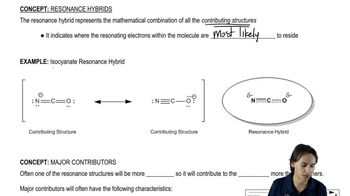
The resonance hybrid is the most stable representation of a molecule, combining the characteristics of all its resonance structures. It reflects the delocalization of electrons, resulting in bond lengths and angles that are intermediate between those predicted by individual resonance forms. The hybrid is often depicted with dashed lines to indicate partial bonds and charges.
Video consigliato:
03:24
How to draw a resonance hybrid.

Contribution to Resonance Hybrid

The contribution of each resonance structure to the resonance hybrid is determined by factors such as the stability of the structure, the octet rule, and the presence of formal charges. Structures that minimize formal charges and maintain full octets for all atoms are generally more significant contributors. Ranking these structures helps predict the overall electron distribution in the molecule.
Video consigliato:
03:24
How to draw a resonance hybrid.