Explain why the pKa of p-nitrophenol is 7.14, whereas the pKa of m-nitrophenol is 8.39.
Ch. 8 - Delocalized Electrons: Their Effect on Stability, pKa, and the Products of a Reaction • Aromaticity and Electronic Effects: An Introduction to the Reactions of Benzene
Tutti i libri di testo
Bruice 8th Edition
Ch. 8 - Delocalized Electrons: Their Effect on Stability, pKa, and the Products of a Reaction • Aromaticity and Electronic Effects: An Introduction to the Reactions of Benzene
Problema 21e,f
Bruice 8th Edition
Ch. 8 - Delocalized Electrons: Their Effect on Stability, pKa, and the Products of a Reaction • Aromaticity and Electronic Effects: An Introduction to the Reactions of Benzene
Problema 21e,fCapitolo 8, Problema 21e,f
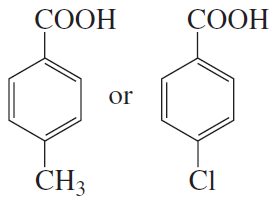
Which acid in each of the following pairs is stronger?
e. 
f. 
Guida verificata passo dopo passo1
Step 1: Analyze the acids in pair A. The first acid (i) is 2,2-dimethylpropanoic acid, and the second acid (ii) is pentanoic acid. Both are carboxylic acids, but the strength of an acid is influenced by the stability of its conjugate base.
Step 2: Consider the inductive effect in pair A. The bulky methyl groups in acid (i) are electron-donating, which destabilizes the conjugate base and makes the acid weaker. In contrast, acid (ii) has no such electron-donating groups, making its conjugate base more stable and the acid stronger.
Step 3: Analyze the acids in pair B. The first acid (i) is benzoic acid, and the second acid (ii) is 4-bromobenzoic acid. Both are aromatic carboxylic acids, but substituents on the benzene ring can influence acidity through inductive and resonance effects.
Step 4: Consider the substituent effects in pair B. Bromine in acid (ii) is an electron-withdrawing group due to its inductive effect, which stabilizes the conjugate base and increases the acidity. In contrast, the hydrogen substituent in acid (i) has no electron-withdrawing effect, making it less acidic.
Step 5: Conclude that in pair A, pentanoic acid (ii) is stronger due to the absence of destabilizing electron-donating groups, and in pair B, 4-bromobenzoic acid (ii) is stronger due to the electron-withdrawing effect of bromine.

Risposta video verificata per un problema simile:
Questa soluzione video è stata consigliata dai nostri tutor come utile per risolvere questo problema.
Durata del video:
6mConcetti chiave
Ecco i concetti essenziali che devi comprendere per rispondere correttamente alla domanda.
Acid Strength and Stability of Conjugate Base
The strength of an acid is often determined by the stability of its conjugate base. A more stable conjugate base corresponds to a stronger acid. Factors influencing stability include electronegativity, resonance, and inductive effects. For example, if a conjugate base can delocalize negative charge through resonance, it will be more stable, thus indicating a stronger acid.
Video consigliato:
Stability of Conjugated Intermediates
Inductive Effect
The inductive effect refers to the electron-withdrawing or electron-donating effects of substituents on a molecule. Electron-withdrawing groups (like halogens) can stabilize the negative charge on a conjugate base, enhancing acid strength. In the given pairs, the presence of bromine in one of the acids can increase acidity due to its inductive effect, making the acid stronger.
Video consigliato:
Understanding the Inductive Effect.
Resonance Stabilization
Resonance stabilization occurs when a molecule can be represented by multiple valid Lewis structures, allowing for the delocalization of electrons. In carboxylic acids, resonance can stabilize the conjugate base formed after deprotonation. The more resonance structures available for the conjugate base, the more stable it is, leading to a stronger acid. This concept is crucial for comparing the acids in the provided pairs.
Video consigliato:
The radical stability trend.
Pratica correlata
Domanda del libro di testo
1769
views
Domanda del libro di testo
For each of the following substituents, indicate whether it withdraws electrons inductively, donates electrons by hyperconjugation, withdraws electrons by resonance, or donates electrons by resonance.
d. NHCH3
e. OCH3
f. +N(CH3)3
1098
views
Domanda del libro di testo
Which acid in each of the following pairs is stronger?
c.
d.
1302
views
Domanda del libro di testo
What is the major product obtained from the addition of HBr to the following compound?
1101
views
Domanda del libro di testo
What is the major product of each of the following reactions, assuming that one equivalent of each reagent is used in each reaction?
b.
1285
views
Domanda del libro di testo
For each of the following substituents, indicate whether it withdraws electrons inductively, donates electrons by hyperconjugation, withdraws electrons by resonance, or donates electrons by resonance.
a. Br
b. CH2CH3
c.
1287
views