Ch. 8 - Delocalized Electrons: Their Effect on Stability, pKa, and the Products of a Reaction • Aromaticity and Electronic Effects: An Introduction to the Reactions of Benzene
Bruice - Organic Chemistry 8th Edition
Bruice8th EditionOrganic ChemistryISBN: 9780135213711Non è quello che usi tu?Cambia libro di testo
Capitolo 8, Problema 69a

Which ion in each of the following pairs is more stable?
a. Two triangular symbols representing ions, with the word "or" between them, indicating a comparison of stability.

Guida verificata passo dopo passo
1
Analyze the structures provided: The left structure represents a cyclopropyl anion (negative charge), while the right structure represents a cyclopropyl cation (positive charge). Cyclopropane is a strained ring system due to its small bond angles, which deviate significantly from the ideal tetrahedral angle of 109.5°.
Consider the electronic effects: The cyclopropyl ring has significant angle strain and torsional strain. The negative charge in the cyclopropyl anion is localized on the carbon atom, which is destabilized due to the strain and lack of resonance stabilization. On the other hand, the cyclopropyl cation benefits from hyperconjugation and inductive effects, which can help delocalize the positive charge to some extent.
Evaluate resonance and stabilization: The cyclopropyl cation is stabilized by the overlap of the σ-bonds in the ring with the empty p-orbital of the positively charged carbon atom. This interaction is known as σ-conjugation, which provides additional stability to the cation. The cyclopropyl anion lacks such stabilization mechanisms.
Compare the stability of the ions: The cyclopropyl cation is more stable than the cyclopropyl anion due to the presence of σ-conjugation and the ability to delocalize the positive charge, whereas the cyclopropyl anion suffers from localized negative charge and ring strain.
Conclude the comparison: Based on the above analysis, the cyclopropyl cation is the more stable ion in this pair.

Risposta video verificata per un problema simile:

Questa soluzione video è stata consigliata dai nostri tutor come utile per risolvere questo problema.
Durata del video:
3m

Concetti chiave

Ecco i concetti essenziali che devi comprendere per rispondere correttamente alla domanda.

Aromatic Stability

Aromatic compounds are particularly stable due to their cyclic structure and the delocalization of π electrons across the ring. This delocalization leads to a lower energy state, making aromatic systems more stable than non-aromatic or anti-aromatic compounds. The concept of aromaticity is governed by Hückel's rule, which states that a compound must have 4n + 2 π electrons to be considered aromatic.
Video consigliato:
08:19
Intro to Aromaticity

Resonance

Resonance refers to the phenomenon where a molecule can be represented by two or more valid Lewis structures, known as resonance structures. These structures contribute to the overall stability of the molecule, as the actual structure is a hybrid of these forms. In the context of the question, resonance can help explain the stability of the ions by showing how charge distribution can be stabilized through delocalization.
Video consigliato:
03:04
Drawing Resonance Structures

Charge Distribution

Charge distribution is crucial in determining the stability of ions. Ions with charges that can be delocalized over multiple atoms tend to be more stable than those with localized charges. In the given structures, analyzing how the positive charge is distributed can provide insights into which ion is more stable, as a more favorable charge distribution often leads to lower energy and increased stability.
Video consigliato:
01:34
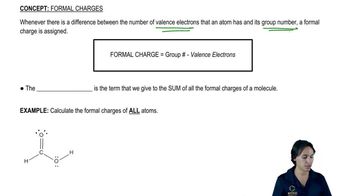
Calculating formal and net charge.