Which reacts faster in an SN1 reaction?
Ch. 9 - Substitution and Elimination Reactions of Alkyl Halides
Tutti i libri di testo
Bruice 8th Edition
Ch. 9 - Substitution and Elimination Reactions of Alkyl Halides
Problema 39a
Bruice 8th Edition
Ch. 9 - Substitution and Elimination Reactions of Alkyl Halides
Problema 39aCapitolo 9, Problema 39a
Which reacts faster in an SN2 reaction?

Guida verificata passo dopo passo1
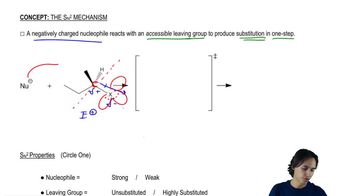
Step 1: Understand the SN2 reaction mechanism. SN2 reactions proceed via a single-step mechanism where the nucleophile attacks the electrophilic carbon and displaces the leaving group simultaneously. The rate of SN2 reactions is highly dependent on steric hindrance around the electrophilic carbon.
Step 2: Analyze the structure of CH3CH2CH2Br. The electrophilic carbon attached to the bromine atom is a primary carbon, meaning it is bonded to only one other carbon atom. Primary carbons experience minimal steric hindrance, making them favorable for SN2 reactions.
Step 3: Analyze the structure of CH3CH2CHCH3 (with Br attached). The electrophilic carbon attached to the bromine atom is a secondary carbon, meaning it is bonded to two other carbon atoms. Secondary carbons experience more steric hindrance compared to primary carbons, which slows down the SN2 reaction rate.
Step 4: Compare steric hindrance between the two molecules. CH3CH2CH2Br has less steric hindrance due to its primary carbon, while CH3CH2CHCH3 has more steric hindrance due to its secondary carbon. Therefore, CH3CH2CH2Br is expected to react faster in an SN2 reaction.
Step 5: Conclude that steric hindrance is the key factor in determining the rate of SN2 reactions. The molecule with the least steric hindrance (CH3CH2CH2Br) will react faster in an SN2 reaction compared to the molecule with more steric hindrance (CH3CH2CHCH3).

Risposta video verificata per un problema simile:
Questa soluzione video è stata consigliata dai nostri tutor come utile per risolvere questo problema.
Durata del video:
2mConcetti chiave
Ecco i concetti essenziali che devi comprendere per rispondere correttamente alla domanda.
SN2 Reaction Mechanism
The SN2 (substitution nucleophilic bimolecular) reaction is a type of nucleophilic substitution where the nucleophile attacks the electrophile simultaneously as the leaving group departs. This concerted mechanism results in a single transition state and is characterized by a backside attack, leading to inversion of configuration at the carbon center. The rate of the reaction depends on both the concentration of the nucleophile and the substrate.
Video consigliato:
Drawing the SN2 Mechanism
Nucleophilicity
Nucleophilicity refers to the strength of a nucleophile, which is determined by its ability to donate an electron pair to an electrophile. Factors influencing nucleophilicity include charge, electronegativity, and solvent effects. Stronger nucleophiles, such as alkoxides or amines, will react faster in SN2 reactions compared to weaker nucleophiles like water or alcohols.
Video consigliato:
Nucleophilic Addition
Steric Hindrance
Steric hindrance is the prevention of reactions due to the spatial arrangement of atoms within a molecule. In SN2 reactions, steric hindrance at the electrophilic carbon can significantly affect the reaction rate; primary substrates react faster than secondary, while tertiary substrates are typically too hindered to undergo SN2. Thus, understanding the structure of the substrate is crucial for predicting reaction outcomes.
Video consigliato:
Understanding steric effects.
Pratica correlata
Domanda del libro di testo
1390
views
Domanda del libro di testo
You were told in [SECTION 7.11] that is best to use a methyl halide or a primary alkyl halide for the reaction of an acetylide ion with an alkyl halide. Explain why this is so.
1136
views
Domanda del libro di testo
Draw the substitution and elimination products for the following reactions, showing the configuration of each product:
c. 1-chloro-1-methylcyclohexane + CH3O−
d. 1-chloro-1-methylcyclohexane + CH3OH
950
views
Domanda del libro di testo
Draw the substitution and elimination products for the following reactions, showing the configuration of each product:
b. cis-1-chloro-2-methylcyclohexane + CH3O−
1405
views
Domanda del libro di testo
Which reacts faster in an E1 reaction?
1265
views
Domanda del libro di testo
Draw the substitution and elimination products for the following reactions, showing the configuration of each product:
a. trans-1-chloro-2-methylcyclohexane + CH3O−
1895
views