Ch. 9 - Substitution and Elimination Reactions of Alkyl Halides
Bruice - Organic Chemistry 8th Edition
Bruice8th EditionOrganic ChemistryISBN: 9780135213711Non è quello che usi tu?Cambia libro di testo
Capitolo 9, Problema 39b

Which reacts faster in an E1 reaction?

Guida verificata passo dopo passo
1
Step 1: Understand the E1 reaction mechanism. E1 reactions are unimolecular elimination reactions where the rate-determining step involves the formation of a carbocation intermediate. The stability of the carbocation formed is a key factor in determining the reaction rate.
Step 2: Analyze the leaving groups in the given molecules. In the first molecule, the leaving group is iodine (I), and in the second molecule, the leaving group is bromine (Br). The ability of a leaving group to depart is influenced by its size and electronegativity.
Step 3: Compare the leaving group abilities of iodine and bromine. Iodine is a better leaving group than bromine because it is larger and can stabilize the negative charge better after leaving. This makes the molecule with iodine more likely to undergo the E1 reaction faster.
Step 4: Consider the carbocation stability. Both molecules form a secondary carbocation upon the departure of the leaving group. Since the carbocation environments are identical, the leaving group ability becomes the deciding factor.
Step 5: Conclude that the molecule with iodine as the leaving group reacts faster in an E1 reaction due to iodine's superior leaving group ability compared to bromine.

Risposta video verificata per un problema simile:

Questa soluzione video è stata consigliata dai nostri tutor come utile per risolvere questo problema.
Durata del video:
2m

Concetti chiave

Ecco i concetti essenziali che devi comprendere per rispondere correttamente alla domanda.

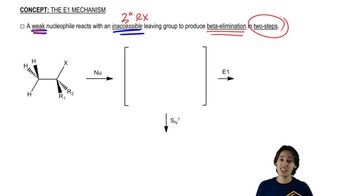
E1 Reaction Mechanism

The E1 reaction is a type of elimination reaction that occurs in two steps: first, the formation of a carbocation intermediate, followed by the loss of a proton to form a double bond. The rate of an E1 reaction depends primarily on the stability of the carbocation formed, as the first step is the rate-determining step. Thus, more stable carbocations, such as tertiary carbocations, will react faster.
Video consigliato:
08:09
Drawing the E1 Mechanism.

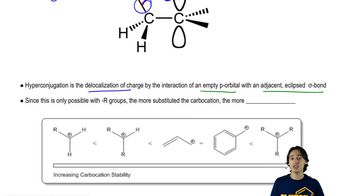
Carbocation Stability

Carbocation stability is a crucial factor in determining the rate of E1 reactions. Carbocations are positively charged species that can be stabilized by hyperconjugation and inductive effects from adjacent alkyl groups. Tertiary carbocations are the most stable due to the presence of three alkyl groups, while primary carbocations are the least stable, influencing the speed of the reaction.
Video consigliato:
05:58
Determining Carbocation Stability

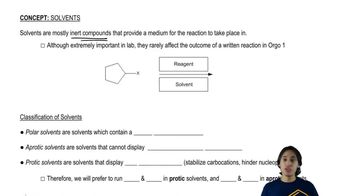
Solvent Effects on E1 Reactions

The choice of solvent can significantly impact the rate of E1 reactions. Polar protic solvents stabilize carbocations through solvation, which can enhance the reaction rate. In contrast, polar aprotic solvents may not stabilize the carbocation as effectively, leading to slower reaction rates. Understanding solvent effects is essential for predicting the reactivity of different substrates in E1 reactions.
Video consigliato:
02:26
General format of reactions and how to interpret solvents.