Ch. 9 - Substitution and Elimination Reactions of Alkyl Halides
Bruice - Organic Chemistry 8th Edition
Bruice8th EditionOrganic ChemistryISBN: 9780135213711Non è quello che usi tu?Cambia libro di testo
Capitolo 9, Problema 77a,b

Draw the substitution products for each of the following reactions; if the products can exist as stereoisomers, show what stereoisomers are obtained:
a. (R)-2-bromopentane+CH3O−
b. (R)-3-bromo-3-methylheptane+CH3OH

Guida verificata passo dopo passo
1
Step 1: Identify the type of substitution reaction occurring in each case. For (R)-2-bromopentane + CH3O−, the reaction involves a strong nucleophile (CH3O−) and a secondary alkyl halide, which suggests an SN2 mechanism. For (R)-3-bromo-3-methylheptane + CH3OH, the reaction involves a weak nucleophile (CH3OH) and a tertiary alkyl halide, which suggests an SN1 mechanism.
Step 2: For the SN2 reaction (part a), recall that SN2 reactions proceed via a backside attack, leading to inversion of configuration at the stereocenter. Draw the product by replacing the bromine atom with the methoxy group (CH3O−) and invert the stereochemistry from (R) to (S).
Step 3: For the SN1 reaction (part b), recall that SN1 reactions proceed via the formation of a carbocation intermediate. The bromine atom leaves first, forming a tertiary carbocation. Since the carbocation is planar, the nucleophile (CH3OH) can attack from either side, leading to a racemic mixture of stereoisomers (both R and S configurations).
Step 4: Draw the substitution product for part a, ensuring the stereochemistry is inverted due to the SN2 mechanism. For part b, draw both stereoisomers (R and S configurations) resulting from the SN1 mechanism.
Step 5: Verify the stereochemistry of the products and ensure that all substituents are correctly placed. For part a, confirm the inversion of configuration. For part b, confirm the formation of a racemic mixture due to the planar carbocation intermediate.

Risposta video verificata per un problema simile:

Questa soluzione video è stata consigliata dai nostri tutor come utile per risolvere questo problema.
Durata del video:
11m

Concetti chiave

Ecco i concetti essenziali che devi comprendere per rispondere correttamente alla domanda.

Nucleophilic Substitution

Nucleophilic substitution is a fundamental reaction in organic chemistry where a nucleophile replaces a leaving group in a molecule. In this context, the nucleophile (CH3O− or CH3OH) attacks the carbon atom bonded to the bromine atom, leading to the formation of a new bond and the release of bromide ion. Understanding the mechanism (either SN1 or SN2) is crucial for predicting the products and their stereochemistry.
Video consigliato:
01:47
Nucleophiles and Electrophiles can react in Substitution Reactions.

Stereochemistry

Stereochemistry refers to the study of the spatial arrangement of atoms in molecules and how this affects their chemical behavior. In the given reactions, the presence of chiral centers means that different stereoisomers can be formed. Recognizing how nucleophilic attacks can lead to different configurations (R/S) is essential for accurately depicting the products and their stereochemical relationships.
Video consigliato:
Percorso guidato
1:38
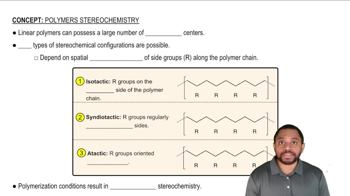
Polymer Stereochemistry Concept 1

Chirality and Stereoisomers

Chirality is a property of a molecule that makes it non-superimposable on its mirror image, often due to the presence of a chiral center (typically a carbon atom with four different substituents). In the reactions provided, the starting materials are chiral, and the substitution can yield different stereoisomers, including enantiomers and diastereomers. Identifying these stereoisomers is important for understanding the full scope of the reaction products.
Video consigliato:
05:10
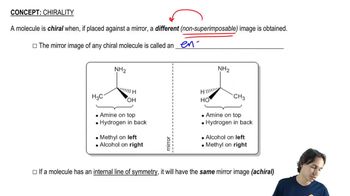
What is chirality?