Ch. 9 - Substitution and Elimination Reactions of Alkyl Halides
Bruice - Organic Chemistry 8th Edition
Bruice8th EditionOrganic ChemistryISBN: 9780135213711Non è quello che usi tu?Cambia libro di testo
Capitolo 9, Problema 42

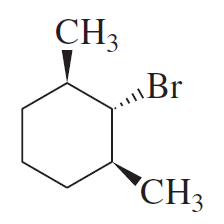
Explain why only a substitution product and no elimination product is obtained when the following ­compound reacts with sodium methoxide:
Brominated cyclohexane with two methyl groups, illustrating the anti-coplanar arrangement for elimination reactions.

Guida verificata passo dopo passo
1
Step 1: Analyze the structure of the compound. The molecule is a cyclohexane ring with two ethyl groups attached in a trans configuration and an iodine atom attached in an axial position. Sodium methoxide (CH3ONa) is a strong nucleophile and base.
Step 2: Consider the reaction mechanism. Sodium methoxide can act as a nucleophile in a substitution reaction or as a base in an elimination reaction. The axial iodine atom is a good leaving group, making the molecule prone to nucleophilic substitution.
Step 3: Evaluate steric hindrance for elimination. For elimination to occur, a β-hydrogen must be anti-periplanar to the leaving group (iodine). In this case, the β-hydrogens on the cyclohexane ring are equatorial, and none are anti-periplanar to the axial iodine. This geometric constraint prevents elimination.
Step 4: Favor substitution. Since elimination is sterically hindered, substitution becomes the favored pathway. Sodium methoxide attacks the carbon bonded to iodine, replacing the iodine with a methoxy group (CH3O−). This reaction proceeds via an SN2 mechanism due to the strong nucleophile and the primary nature of the carbon attached to iodine.
Step 5: Conclude why elimination does not occur. The lack of anti-periplanar β-hydrogens and the favorable conditions for SN2 substitution explain why only the substitution product is obtained in this reaction.

Risposta video verificata per un problema simile:

Questa soluzione video è stata consigliata dai nostri tutor come utile per risolvere questo problema.
Durata del video:
2m

Concetti chiave

Ecco i concetti essenziali che devi comprendere per rispondere correttamente alla domanda.

Nucleophilic Substitution Reactions

Nucleophilic substitution reactions involve the replacement of a leaving group in a molecule by a nucleophile. In this case, sodium methoxide (CH3ONa) acts as a nucleophile, attacking the carbon atom bonded to the iodine (the leaving group). The reaction typically follows either an SN1 or SN2 mechanism, depending on the structure of the substrate and the conditions.
Video consigliato:
01:47
Nucleophiles and Electrophiles can react in Substitution Reactions.

Elimination Reactions

Elimination reactions involve the removal of a small molecule (like water or hydrogen halide) from a larger molecule, resulting in the formation of a double bond. The E2 mechanism is a common type of elimination that requires a strong base and typically occurs in a concerted manner. However, in this scenario, the steric hindrance and the structure of the substrate favor substitution over elimination.
Video consigliato:
00:40
Recognizing Elimination Reactions.

Steric Hindrance

Steric hindrance refers to the prevention of reactions due to the spatial arrangement of atoms within a molecule. In this case, the bulky substituents on the cyclohexane ring create significant steric hindrance, making it difficult for the base to access the hydrogen atoms necessary for elimination. This steric effect favors the nucleophilic substitution pathway, leading to the formation of a substitution product instead of an elimination product.
Video consigliato:
02:53
Understanding steric effects.