

Ch. 9 - Substitution and Elimination Reactions of Alkyl Halides
Bruice - Organic Chemistry 8th Edition
Bruice8th EditionOrganic ChemistryISBN: 9780135213711Non è quello che usi tu?Cambia libro di testo
Capitolo 9, Problema 122

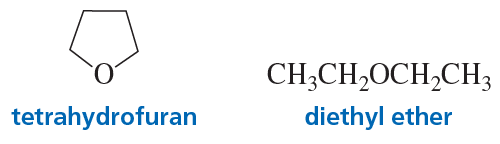
Explain why tetrahydrofuran can solvate a positively charged species better than diethyl ether can.
Structural formulas of tetrahydrofuran and diethyl ether, highlighting their differences in solvation abilities.

Guida verificata passo dopo passo
1
Tetrahydrofuran (THF) is a cyclic ether with a five-membered ring containing an oxygen atom. Diethyl ether, on the other hand, is an acyclic ether with two ethyl groups attached to the oxygen atom. The structural difference plays a key role in their ability to solvate positively charged species.
The oxygen atom in THF is part of a ring structure, which makes it more accessible for interaction with positively charged species. In diethyl ether, the oxygen atom is surrounded by bulky ethyl groups, which can hinder its ability to interact with cations.
THF has a higher dipole moment compared to diethyl ether due to its cyclic structure. A higher dipole moment means that THF can create stronger dipole-dipole interactions with positively charged species, enhancing its solvating ability.
The cyclic nature of THF also allows for a more rigid and organized solvation shell around the positively charged species. This structural advantage improves the stabilization of the cation compared to the more flexible and less organized solvation shell formed by diethyl ether.
In summary, THF's cyclic structure, higher dipole moment, and accessibility of the oxygen atom make it a better solvent for positively charged species compared to diethyl ether.

Risposta video verificata per un problema simile:

Questa soluzione video è stata consigliata dai nostri tutor come utile per risolvere questo problema.
Durata del video:
1m

Concetti chiave

Ecco i concetti essenziali che devi comprendere per rispondere correttamente alla domanda.

Polarity and Solvation

Polarity refers to the distribution of electrical charge over the atoms in a molecule. Tetrahydrofuran (THF) is a polar aprotic solvent, which means it can stabilize charged species through dipole interactions. This ability to solvate positively charged species is crucial in reactions like SN1, where the stability of the carbocation intermediate is enhanced by solvation.
Video consigliato:
2:04
Molecular Polarity

Structure of Solvents

The molecular structure of a solvent affects its solvation capabilities. Tetrahydrofuran has a five-membered ring with an oxygen atom, allowing for a more effective interaction with cations due to its ring strain and polar nature. In contrast, diethyl ether has a linear structure that limits its ability to interact with charged species, making it less effective in solvation.
Video consigliato:
01:16
Identification of polarity in solvents

Dielectric Constant

The dielectric constant is a measure of a solvent's ability to reduce the electrostatic forces between charged particles. Tetrahydrofuran has a higher dielectric constant compared to diethyl ether, which means it can better stabilize ions in solution. This property is essential for facilitating reactions involving charged intermediates, such as those seen in SN1 mechanisms.
Video consigliato:
02:19
The relationship between equilibrium constant and pKa.