Ch. 9 - Substitution and Elimination Reactions of Alkyl Halides
Bruice - Organic Chemistry 8th Edition
Bruice8th EditionOrganic ChemistryISBN: 9780135213711Non è quello che usi tu?Cambia libro di testo
Capitolo 9, Problema 23e

What is the major elimination product obtained from an E2 reaction of each of the following alkyl halides with hydroxide ion?
e.

Guida verificata passo dopo passo
1
Step 1: Identify the alkyl halide structure. The given molecule is a cyclohexane ring with a bromine atom attached to one of the carbons. This is a secondary alkyl halide because the carbon bonded to bromine is connected to two other carbons.
Step 2: Recall the mechanism of an E2 reaction. In an E2 elimination, a strong base (here, hydroxide ion) removes a proton from a β-carbon (a carbon adjacent to the carbon bonded to the leaving group), while the leaving group (bromine) departs simultaneously. This results in the formation of a double bond.
Step 3: Determine the β-hydrogens available for elimination. In this case, the β-carbons are the two carbons adjacent to the carbon bonded to bromine. Each β-carbon has hydrogens that can be abstracted by the hydroxide ion.
Step 4: Apply Zaitsev's rule to predict the major product. Zaitsev's rule states that the most substituted alkene will be the major product. Therefore, the double bond will form between the carbon bonded to bromine and the β-carbon that leads to the more substituted alkene.
Step 5: Draw the major elimination product. The double bond will form in the cyclohexane ring, resulting in a more stable, substituted alkene. Ensure the stereochemistry and regiochemistry are consistent with the E2 mechanism.

Risposta video verificata per un problema simile:

Questa soluzione video è stata consigliata dai nostri tutor come utile per risolvere questo problema.
Durata del video:
3m

Concetti chiave

Ecco i concetti essenziali che devi comprendere per rispondere correttamente alla domanda.

E2 Reaction Mechanism

The E2 (bimolecular elimination) reaction is a concerted mechanism where a base abstracts a proton from a β-carbon while a leaving group departs from the α-carbon, resulting in the formation of a double bond. This reaction typically requires strong bases and occurs in a single step, making it essential to understand the stereochemistry and orientation of the substrate.
Video consigliato:
09:36
Drawing the E2 Mechanism.

Alkyl Halides

Alkyl halides are organic compounds containing a carbon atom bonded to a halogen atom (such as bromine, chlorine, or iodine). Their reactivity in elimination reactions depends on the structure of the alkyl group and the nature of the leaving group. In the case of bromobenzene, the halogen is attached to a benzene ring, which influences the reaction pathway.
Video consigliato:
01:52
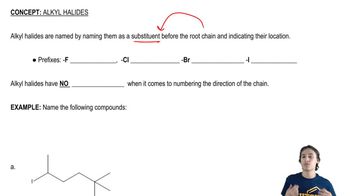
How to name alkyl halides

Regioselectivity in Elimination Reactions

Regioselectivity refers to the preference of a chemical reaction to yield one structural isomer over others. In E2 reactions, the formation of the double bond can lead to different products depending on the orientation of the leaving group and the hydrogen being abstracted. Understanding regioselectivity is crucial for predicting the major product in reactions involving complex substrates like bromobenzene.
Video consigliato:
00:40
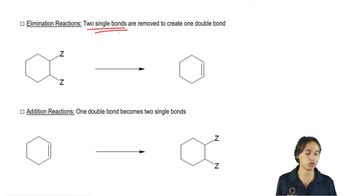
Recognizing Elimination Reactions.