Ch. 9 - Substitution and Elimination Reactions of Alkyl Halides
Bruice - Organic Chemistry 8th Edition
Bruice8th EditionOrganic ChemistryISBN: 9780135213711Non è quello che usi tu?Cambia libro di testo
Capitolo 9, Problema 91

When the following reactions are carried out under the same conditions, the rate constant for the first reaction (kH) is found to be 7 times greater than the rate constant for the second reaction (kD). What does that tell you about the mechanism of the reaction? (Hint: a C—D bond is 1.2 kcal/mol stronger than a C—H bond.)
Chemical reactions showing E2 mechanisms with rate constants kH and kD, highlighting bond strength differences.

Guida verificata passo dopo passo
1
Step 1: Analyze the given reactions. The first reaction involves a substrate with C—H bonds, while the second reaction involves a substrate with C—D bonds. Both reactions proceed under identical conditions and produce similar products, but the rate constant for the reaction with C—H bonds (kH) is 7 times greater than the rate constant for the reaction with C—D bonds (kD).
Step 2: Understand the hint provided. The hint states that a C—D bond is 1.2 kcal/mol stronger than a C—H bond. This means that breaking a C—D bond requires more energy compared to breaking a C—H bond. This difference in bond strength is a key factor influencing the reaction rate.
Step 3: Consider the mechanism of the reaction. The reaction likely involves the breaking of the C—H or C—D bond in the rate-determining step. Since the C—D bond is stronger, it is harder to break, leading to a slower reaction rate for the second reaction compared to the first.
Step 4: Relate the observed rate constant difference to the kinetic isotope effect. The kinetic isotope effect occurs when the substitution of an isotope (e.g., hydrogen with deuterium) significantly affects the reaction rate. The fact that kH is 7 times greater than kD suggests a primary kinetic isotope effect, indicating that the bond to hydrogen or deuterium is being broken in the rate-determining step.
Step 5: Conclude that the mechanism of the reaction involves the cleavage of the C—H or C—D bond in the rate-determining step. The observed rate constant difference and the kinetic isotope effect provide strong evidence for this conclusion.

Risposta video verificata per un problema simile:

Questa soluzione video è stata consigliata dai nostri tutor come utile per risolvere questo problema.
Durata del video:
4m

Concetti chiave

Ecco i concetti essenziali che devi comprendere per rispondere correttamente alla domanda.

Kinetic Isotope Effect (KIE)

The kinetic isotope effect refers to the change in reaction rate that occurs when one atom in a molecule is replaced by one of its isotopes. In this case, the C—D bond is stronger than the C—H bond, leading to a slower reaction rate when breaking the C—D bond. The observed rate constant difference (kH > kD) indicates that the C—H bond is more easily broken, suggesting that the bond cleavage is a significant step in the reaction mechanism.
Video consigliato:
03:06
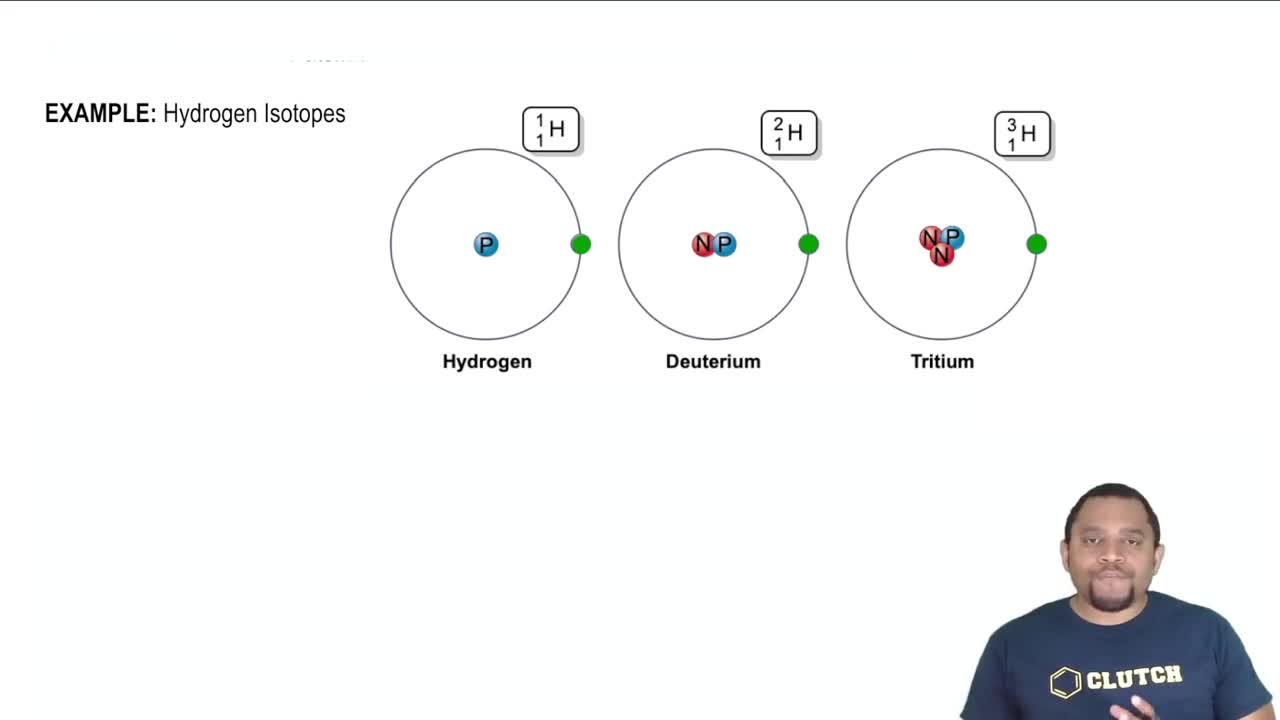
Understanding the hydrogen isotopes.

Reaction Mechanism

A reaction mechanism is a step-by-step description of the pathway taken by reactants to form products. Understanding the mechanism helps in predicting the rate of reaction and the influence of various factors, such as bond strengths. In this case, the difference in rate constants suggests that the mechanism likely involves a transition state where the C—H bond is broken, confirming that bond strength plays a crucial role in determining the reaction's rate.
Video consigliato:
02:16
Heck Reaction Mechanism

Bond Strength and Stability

Bond strength refers to the energy required to break a bond between two atoms. In this scenario, the C—D bond is 1.2 kcal/mol stronger than the C—H bond, which means that reactions involving C—D bonds will generally proceed more slowly due to the increased energy required to break these bonds. This concept is essential for understanding why the rate constant for the reaction involving C—D bonds is lower compared to that involving C—H bonds.
Video consigliato:
03:43
The radical stability trend.