




Ch. 9 - Substitution and Elimination Reactions of Alkyl Halides
Bruice - Organic Chemistry 8th Edition
Bruice8th EditionOrganic ChemistryISBN: 9780135213711Non è quello che usi tu?Cambia libro di testo
Capitolo 9, Problema 88

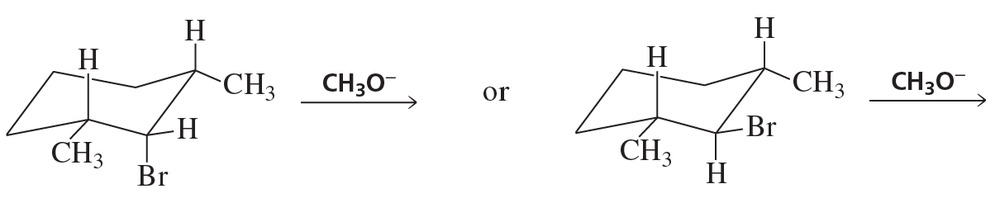
Which reactant in each of the following pairs undergoes an elimination reaction more rapidly? Explain your choice.
a. Comparison of two reactants, (CH3)3CCl and (CH3)3CBr, for elimination reaction rates with CH3O− as the base.
b. Two molecular structures showing elimination reactions with CH3O- as a reactant, comparing two pairs of reactants.

Guida verificata passo dopo passo
1
Step 1: Analyze the elimination reaction mechanism. Elimination reactions typically proceed via either the E1 or E2 mechanism. The E2 mechanism is favored by strong bases like CH3O−, and the rate of elimination depends on the leaving group and the structure of the substrate.
Step 2: Compare the leaving groups in part (a). Bromine (Br) is a better leaving group than chlorine (Cl) because it is larger and more polarizable, making it more stable as a free ion after leaving. Therefore, (CH3)3CBr will undergo elimination more rapidly than (CH3)3CCl.
Step 3: Examine the steric hindrance in part (b). In elimination reactions, the anti-periplanar geometry is crucial for the E2 mechanism. The structure of the cyclohexane ring affects the availability of anti-periplanar hydrogens relative to the leaving group. In structure (ii), the bulky methyl group at the axial position increases steric hindrance, making elimination less favorable compared to structure (i).
Step 4: Consider the position of the leaving group in part (b). In structure (i), the chlorine atom is positioned in a way that allows for easier anti-periplanar elimination compared to structure (ii), where steric hindrance from the methyl group interferes with the elimination process.
Step 5: Summarize the findings. For part (a), (CH3)3CBr undergoes elimination more rapidly due to the superior leaving group. For part (b), structure (i) undergoes elimination more rapidly due to less steric hindrance and better anti-periplanar geometry.

Risposta video verificata per un problema simile:

Questa soluzione video è stata consigliata dai nostri tutor come utile per risolvere questo problema.
Durata del video:
8m

Concetti chiave

Ecco i concetti essenziali che devi comprendere per rispondere correttamente alla domanda.

Elimination Reactions

Elimination reactions involve the removal of a small molecule from a larger one, typically resulting in the formation of a double bond. In organic chemistry, these reactions often occur with alkyl halides, where a leaving group (like Cl or Br) is expelled, and a pi bond is formed. The rate of elimination can depend on factors such as the strength of the leaving group and the stability of the resulting alkene.
Video consigliato:
00:40
Recognizing Elimination Reactions.

Leaving Group Ability

The ability of a leaving group to depart from a molecule is crucial in determining the rate of elimination reactions. Generally, better leaving groups, such as bromide (Br-) compared to chloride (Cl-), facilitate faster reactions. This is because better leaving groups stabilize the negative charge better after leaving, making the transition state lower in energy and thus more favorable.
Video consigliato:
03:06
How to use the factors affecting acidity to predict leaving group ability.

Steric Hindrance

Steric hindrance refers to the crowding around a reactive center in a molecule, which can affect reaction rates. In elimination reactions, bulky groups near the leaving group can hinder the approach of the base needed for elimination. Therefore, the structure of the reactants, including the presence of bulky substituents, can significantly influence the rate at which elimination occurs.
Video consigliato:
02:53
Understanding steric effects.