Ch. 10 - Alkynes: Electrophilic Addition and Redox Reactions
Mullins - Organic Chemistry: A Learner Centered Approach 1st Edition
Mullins1st EditionOrganic Chemistry: A Learner Centered ApproachISBN: 9780137566471Non è quello che usi tu?Cambia libro di testo
Capitolo 9, Problema 24c

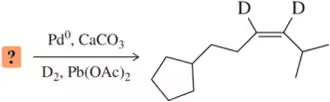
Hydrogenation of which alkynes would produce the following cis-alkenes?
(c) Chemical reaction diagram showing hydrogenation conditions for producing cis-alkenes from alkynes, with labeled components.

Guida verificata passo dopo passo
1
Identify the reaction type: The problem involves the hydrogenation of alkynes to produce cis-alkenes. This is a partial hydrogenation reaction, which uses a specific catalyst to stop the reaction at the alkene stage and ensure the formation of a cis-alkene.
Understand the catalyst: The partial hydrogenation of alkynes to cis-alkenes typically uses a Lindlar catalyst. This is a palladium catalyst that has been poisoned to prevent further hydrogenation to an alkane.
Analyze the product: The given product is a cis-alkene. This means that the two substituents on the double bond are on the same side of the molecule. This stereochemistry is a result of the syn-addition mechanism of hydrogenation using the Lindlar catalyst.
Determine the starting alkyne: To produce a cis-alkene, the starting material must be an alkyne with the same carbon skeleton as the product. The triple bond in the alkyne will be reduced to a double bond in the cis-configuration. For example, if the product is cis-2-butene, the starting alkyne would be 2-butyne.
Verify the structure: Ensure that the alkyne you propose as the starting material has the correct connectivity and number of carbons to match the cis-alkene product after partial hydrogenation.

Risposta video verificata per un problema simile:

Questa soluzione video è stata consigliata dai nostri tutor come utile per risolvere questo problema.
Durata del video:
2m

Concetti chiave

Ecco i concetti essenziali che devi comprendere per rispondere correttamente alla domanda.

Alkynes

Alkynes are hydrocarbons that contain at least one carbon-carbon triple bond. They are unsaturated compounds and are generally more reactive than alkenes and alkanes due to the presence of the triple bond. Understanding the structure and reactivity of alkynes is crucial for predicting the products of reactions such as hydrogenation.
Video consigliato:
09:11
Alkyne Hydration

Hydrogenation

Hydrogenation is a chemical reaction that involves the addition of hydrogen (H2) to an unsaturated compound, such as alkenes or alkynes, resulting in the formation of saturated compounds. This process can be catalyzed by metals like palladium, platinum, or nickel. The stereochemistry of the hydrogenation reaction can lead to the formation of cis or trans isomers, depending on the conditions and the substrate.
Video consigliato:
00:48
The definition of hydrogenation.

Stereochemistry

Stereochemistry refers to the study of the spatial arrangement of atoms in molecules and how this affects their chemical behavior. In the context of hydrogenation, the formation of cis-alkenes involves the addition of hydrogen atoms to the same side of the double bond, resulting in a specific geometric isomer. Understanding stereochemistry is essential for predicting the outcome of reactions and the properties of the resulting compounds.
Video consigliato:
Percorso guidato
1:38
Polymer Stereochemistry Concept 1