Ch. 10 - Alkynes: Electrophilic Addition and Redox Reactions
Mullins - Organic Chemistry: A Learner Centered Approach 1st Edition
Mullins1st EditionOrganic Chemistry: A Learner Centered ApproachISBN: 9780137566471Non è quello che usi tu?Cambia libro di testo
Capitolo 9, Problema 19a

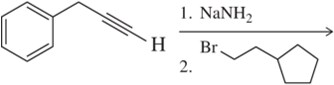
Predict the product of the following acetylide alkylations.
(a) Chemical structure showing an acetylide reacting with sodium amide and a bromide, predicting the product of alkylation.

Guida verificata passo dopo passo
1
Step 1: Understand the reaction mechanism. Acetylide alkylation involves the reaction of a terminal alkyne with a strong base to form an acetylide ion, followed by the reaction of the acetylide ion with an alkyl halide to form a new carbon-carbon bond.
Step 2: Deprotonate the terminal alkyne. Use a strong base, such as sodium amide (NaNH₂), to remove the acidic proton from the terminal alkyne, forming the acetylide ion. The reaction can be represented as: R-C≡CH+NaNH→R-C≡C-Na++NH3.
Step 3: Identify the alkyl halide. The acetylide ion will react with an alkyl halide (e.g., R'-X, where X is a leaving group such as Br or I) in an SN2 reaction. This step forms a new carbon-carbon bond.
Step 4: Perform the SN2 reaction. The acetylide ion acts as a nucleophile and attacks the electrophilic carbon of the alkyl halide, displacing the leaving group. The reaction can be represented as: R-C≡C-Na++R'X→R-C≡CR'+NaX.
Step 5: Predict the product. Combine the alkyne fragment (R-C≡C-) with the alkyl group (R') from the alkyl halide to form the final product, which is a substituted alkyne (R-C≡C-R'). Ensure that the alkyl halide used is primary or methyl to avoid side reactions such as elimination.

Risposta video verificata per un problema simile:

Questa soluzione video è stata consigliata dai nostri tutor come utile per risolvere questo problema.
Durata del video:
1m

Concetti chiave

Ecco i concetti essenziali che devi comprendere per rispondere correttamente alla domanda.

Acetylide Ions

Acetylide ions are negatively charged species formed from terminal alkynes by deprotonation. They are strong nucleophiles due to the high electron density on the carbon atom. Understanding their formation and reactivity is crucial for predicting the outcomes of reactions involving alkylation, where they attack electrophiles to form new carbon-carbon bonds.
Video consigliato:
Percorso guidato
3:39
Metal Ion Catalysis Concept 1

Alkylation Reactions

Alkylation reactions involve the transfer of an alkyl group from one molecule to another, typically through nucleophilic substitution. In the context of acetylide alkylation, the acetylide ion acts as a nucleophile, attacking an alkyl halide or other electrophile to form a new alkyne. Recognizing the mechanism and conditions of these reactions is essential for predicting the final product.
Video consigliato:
03:19
Sodium Alkynide Alkylation

Electrophiles

Electrophiles are species that accept electrons during a chemical reaction, often possessing a positive charge or a partial positive charge. In alkylation reactions, common electrophiles include alkyl halides, which react with nucleophiles like acetylide ions. Understanding the nature of electrophiles helps in predicting which products will form based on the reactivity and sterics of the electrophile involved.
Video consigliato:
03:
Nucleophile or Electrophile