Ch. 10 - Alkynes: Electrophilic Addition and Redox Reactions
Mullins - Organic Chemistry: A Learner Centered Approach 1st Edition
Mullins1st EditionOrganic Chemistry: A Learner Centered ApproachISBN: 9780137566471Non è quello che usi tu?Cambia libro di testo
Capitolo 9, Problema 22a

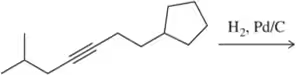
Predict the product of the following hydrogenation reactions.
(a) Chemical structure showing an alkyne undergoing hydrogenation with H₂ and Pd/C catalyst, indicating a reaction pathway.

Guida verificata passo dopo passo
1
Identify the type of compound undergoing hydrogenation. Typically, hydrogenation reactions involve alkenes, alkynes, or aromatic compounds reacting with hydrogen (H₂) in the presence of a catalyst such as Pd, Pt, or Ni.
Determine the functional group that will be affected by the hydrogenation. For example, in alkenes, the π-bond of the double bond will be reduced to a single bond, and in alkynes, the triple bond will be reduced to a double bond or a single bond depending on the reaction conditions.
Write the balanced chemical equation for the reaction. For example, if the starting material is an alkene, add H₂ across the double bond to form the corresponding alkane.
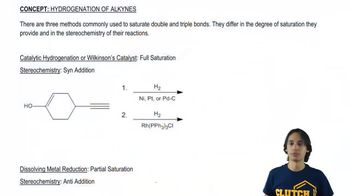
Consider the stereochemistry of the product. In catalytic hydrogenation, the addition of hydrogen is typically syn (both hydrogens add to the same face of the molecule). If the starting material is cyclic, this can lead to specific stereoisomers.
Draw the structure of the product, ensuring that all π-bonds in the affected functional group have been reduced and that the correct stereochemistry is represented if applicable.

Risposta video verificata per un problema simile:

Questa soluzione video è stata consigliata dai nostri tutor come utile per risolvere questo problema.
Durata del video:
2m

Concetti chiave

Ecco i concetti essenziali che devi comprendere per rispondere correttamente alla domanda.

Hydrogenation

Hydrogenation is a chemical reaction that involves the addition of hydrogen (H2) to an unsaturated compound, typically an alkene or alkyne, converting it into a saturated compound. This process is commonly facilitated by catalysts such as palladium, platinum, or nickel, which help lower the activation energy required for the reaction. Understanding hydrogenation is crucial for predicting the products of reactions involving double or triple bonds.
Video consigliato:
00:48
The definition of hydrogenation.

Saturation and Unsaturation

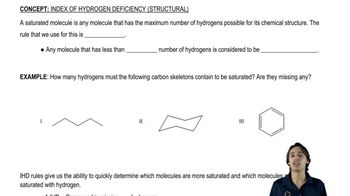
In organic chemistry, saturation refers to the presence of single bonds between carbon atoms, while unsaturation indicates the presence of double or triple bonds. Saturated compounds, like alkanes, have the maximum number of hydrogen atoms, whereas unsaturated compounds, like alkenes and alkynes, have fewer hydrogen atoms due to the presence of multiple bonds. Recognizing the degree of saturation is essential for predicting the outcome of hydrogenation reactions.
Video consigliato:
02:39
The difference between saturated and unsaturated molecules.

Reaction Mechanism

The reaction mechanism describes the step-by-step process by which reactants are converted into products in a chemical reaction. In hydrogenation, the mechanism typically involves the adsorption of hydrogen and the unsaturated compound onto the catalyst's surface, followed by the breaking of bonds and the formation of new bonds. Understanding the mechanism helps in predicting the specific products formed during the reaction and the conditions that may influence the reaction pathway.
Video consigliato:
02:16
Heck Reaction Mechanism