Ch. 10 - Alkynes: Electrophilic Addition and Redox Reactions
Mullins - Organic Chemistry: A Learner Centered Approach 1st Edition
Mullins1st EditionOrganic Chemistry: A Learner Centered ApproachISBN: 9780137566471Non è quello che usi tu?Cambia libro di testo
Capitolo 9, Problema 32

The alkyl carbocation is estimated to be 15 kcal/mol more stable than the alkenyl carbocation. If this is also the difference in the energies of the transition state leading to each, what is the expected rate difference? 
<IMAGE>

Guida verificata passo dopo passo
1
Step 1: Understand the problem. The question asks for the expected rate difference between two reactions based on the energy difference of their transition states. The energy difference between the transition states is given as 15 kcal/mol.
Step 2: Recall the relationship between activation energy and reaction rate. The rate constant (k) is related to the activation energy (Ea) through the Arrhenius equation: k = A * exp(-Ea / RT), where A is the pre-exponential factor, R is the gas constant, and T is the temperature.
Step 3: Use the ratio of rate constants to compare the rates of the two reactions. The ratio of rate constants (k1/k2) can be expressed as: k1/k2 = exp((Ea2 - Ea1) / RT), where Ea2 and Ea1 are the activation energies for the two reactions.
Step 4: Substitute the given energy difference into the equation. The energy difference between the transition states is 15 kcal/mol, which needs to be converted to cal/mol (1 kcal = 1000 cal). Thus, Ea2 - Ea1 = 15000 cal/mol.
Step 5: Simplify the expression for the rate difference. Plug the values into the equation, ensuring the temperature (T) and gas constant (R) are in consistent units. The final expression will allow you to calculate the expected rate difference between the two reactions.

Risposta video verificata per un problema simile:

Questa soluzione video è stata consigliata dai nostri tutor come utile per risolvere questo problema.
Durata del video:
5m

Concetti chiave

Ecco i concetti essenziali che devi comprendere per rispondere correttamente alla domanda.

Carbocation Stability

Carbocations are positively charged carbon species that can vary in stability based on their structure. Alkyl carbocations are generally more stable than alkenyl carbocations due to hyperconjugation and inductive effects from surrounding alkyl groups. This stability influences the energy of the transition states leading to their formation, affecting reaction rates.
Video consigliato:
05:58
Determining Carbocation Stability

Transition State Theory

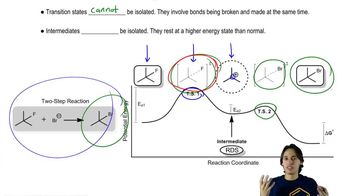
Transition state theory posits that during a chemical reaction, reactants pass through a high-energy transition state before forming products. The energy difference between the reactants and the transition state (activation energy, Ea) determines the rate of the reaction. A lower activation energy correlates with a faster reaction rate, making the understanding of transition states crucial for predicting reaction kinetics.
Video consigliato:
06:55
Intermediates vs. Transition States

Arrhenius Equation

The Arrhenius equation relates the rate constant of a reaction to the temperature and activation energy. It states that the rate constant increases exponentially as the activation energy decreases. This relationship allows for the calculation of expected rate differences when comparing reactions with different activation energies, such as the 15 kcal/mol difference noted in the question.
Video consigliato:
05:02
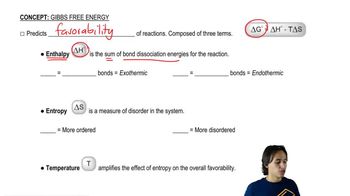
Breaking down the different terms of the Gibbs Free Energy equation.