Ch. 10 - Alkynes: Electrophilic Addition and Redox Reactions
Mullins - Organic Chemistry: A Learner Centered Approach 1st Edition
Mullins1st EditionOrganic Chemistry: A Learner Centered ApproachISBN: 9780137566471Non è quello che usi tu?Cambia libro di testo
Capitolo 9, Problema 27a

The following deprotonation step occurs during the trans reduction of an alkyne. Calculate Keq for this reaction.

Guida verificata passo dopo passo
1
Identify the acids and bases in the reaction. The alkyne (CH≡CH) is the acid being deprotonated, and ammonia (NH₃) is the base. The products are the acetylide anion (C≡C⁻) and the ammonium ion (NH₂⁻).
Determine the pKa values of the acid and conjugate acid. The pKa of CH≡CH is approximately 25, and the pKa of NH₃ is approximately 38.
Use the relationship between pKa values and equilibrium constants (Keq). The formula is: Keq = 10^(pKa(conjugate acid) - pKa(acid)).
Substitute the pKa values into the formula: Keq = 10^(38 - 25).
Interpret the result qualitatively. Since the pKa of NH₃ is much higher than that of CH≡CH, the equilibrium strongly favors the products (C≡C⁻ and NH₂⁻).

Risposta video verificata per un problema simile:

Questa soluzione video è stata consigliata dai nostri tutor come utile per risolvere questo problema.

Concetti chiave

Ecco i concetti essenziali che devi comprendere per rispondere correttamente alla domanda.

Deprotonation

Deprotonation is the removal of a proton (H+) from a molecule, resulting in the formation of a conjugate base. In organic chemistry, this process is crucial for understanding acid-base reactions, particularly in the context of alkynes, which can act as weak acids due to the acidity of their terminal hydrogen. The ability to deprotonate an alkyne is essential for subsequent reactions, such as reductions.
Video consigliato:
Percorso guidato
4:30
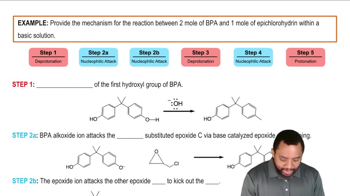
Step-Growth Polymers: Epoxy Resin Example 1

Equilibrium Constant (K_eq)

The equilibrium constant (K_eq) is a numerical value that expresses the ratio of the concentrations of products to reactants at equilibrium for a given chemical reaction. It provides insight into the extent of a reaction and whether it favors the formation of products or reactants. Calculating K_eq involves using the concentrations of the species involved in the reaction at equilibrium, which is vital for understanding the thermodynamics of the deprotonation step.
Video consigliato:
02:19
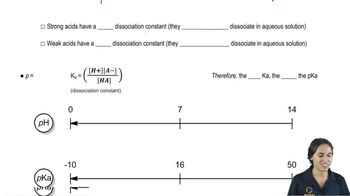
The relationship between equilibrium constant and pKa.

Trans Reduction of Alkynes

The trans reduction of alkynes refers to the conversion of alkynes into trans-alkenes through the addition of hydrogen (H2) in the presence of a catalyst, typically a metal such as palladium or platinum. This reaction is significant in organic synthesis as it allows for the selective formation of trans isomers, which have distinct physical and chemical properties compared to their cis counterparts. Understanding this reduction process is essential for predicting the outcome of the deprotonation step in the reaction.
Video consigliato:
04:40
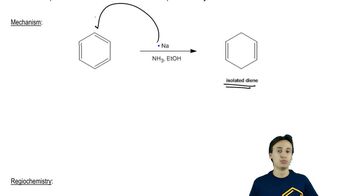
Birch Reduction Mechanism